
Welcome to Tea or Coffee. Explore our practical guides designed for better focus and steady energy throughout your day.
How to Make Cold Brew in a French Press (Ratio + Steep Time)
A French press already does the two things cold brew needs: it steeps grounds and strains them. Here’s how to make cold brew in a French press with exact amounts for a concentrate or a ready-to-drink batch. All you need is coffee, water and a long wait.
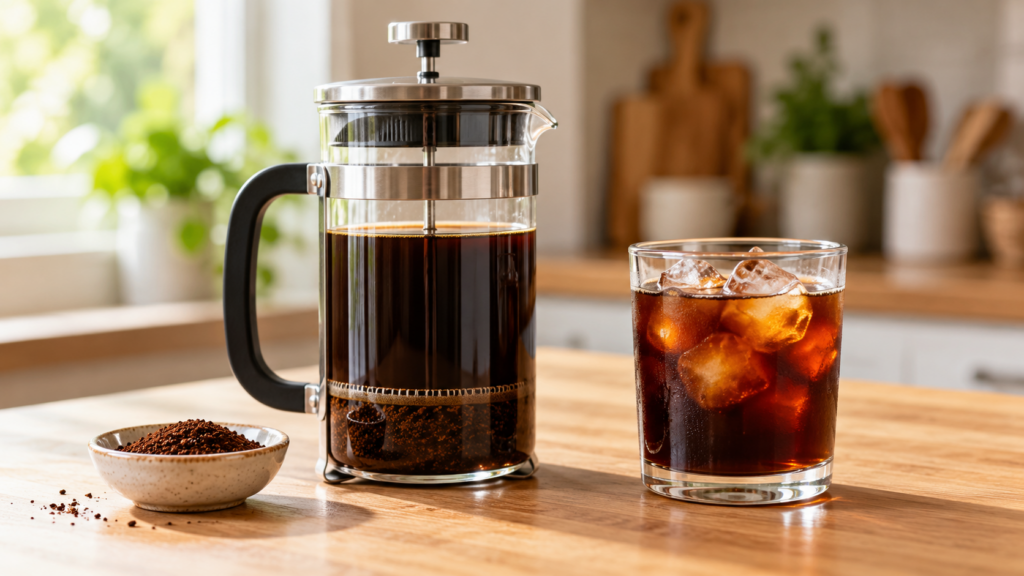
Quick Recipe Card
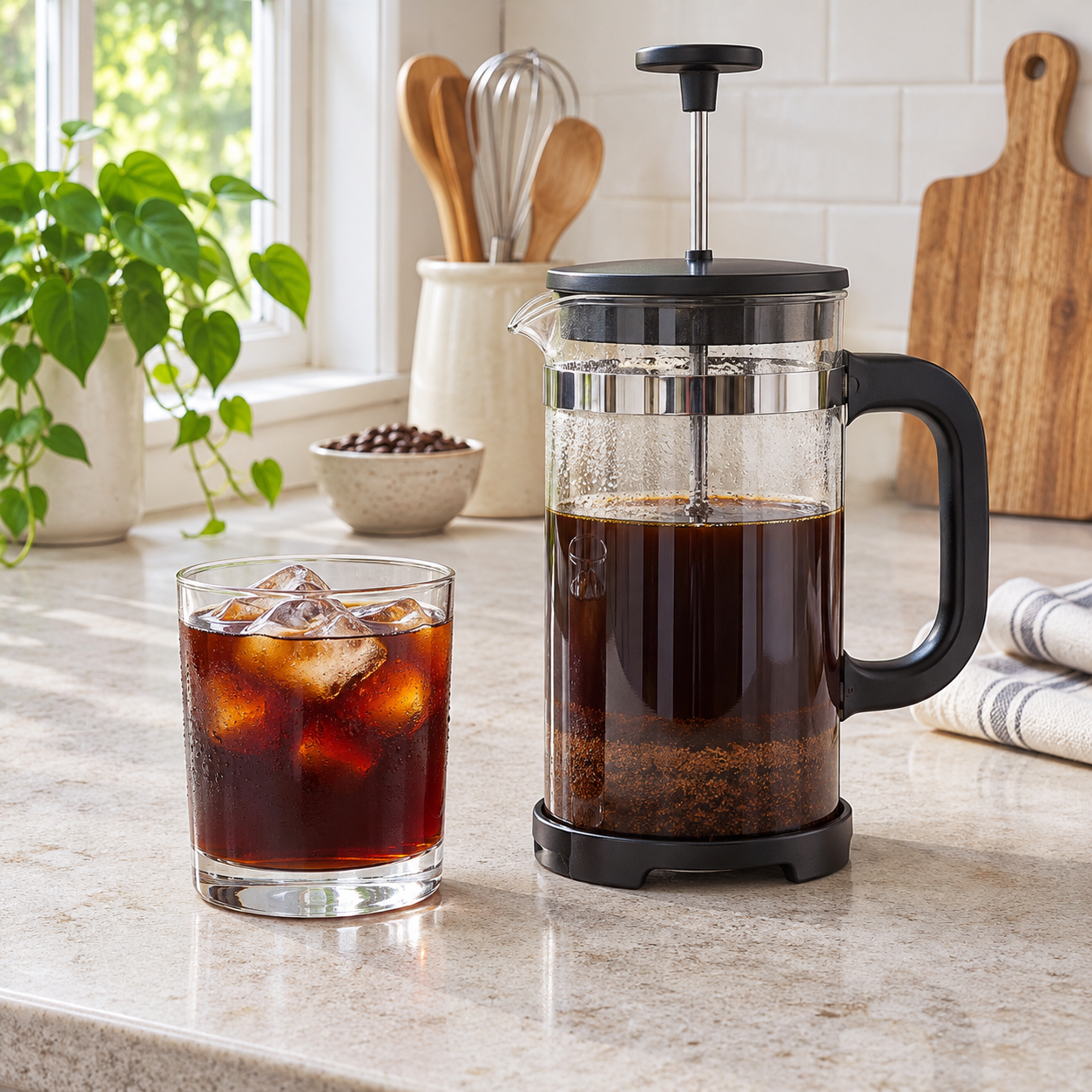
French Press Cold Brew
Choose a concentrate (1:5) or ready-to-drink batch (about 1:11), using coarse grounds and a French press.
Ingredients
Equipment
Method
- Choose one recipe: concentrate uses 100 g coffee and 500 ml water; ready-to-drink uses 45 g coffee and 500 ml water.
- Add the coarse grounds to the French press, pour in the water and stir until every bit is wet. Set the lid on top without pressing.
- Steep for 12 to 24 hours. Start at 16 to 18 hours for your first batch.
- Press the plunger down slowly, then pour through a paper filter into a clean jar or bottle.
- For concentrate, start with 1 part concentrate to 2 parts water or milk and adjust to taste. Ready-to-drink coffee needs no dilution.
- Store sealed in the fridge.
Notes
Use either 100 g coffee for concentrate OR 45 g for ready-to-drink, not both. Concentrate yield: roughly 250–325 ml; diluted 1:2, roughly 750–975 ml, or about 4–5 glasses of 200 ml before ice. Ready-to-drink yield: roughly 390–420 ml, or about 2 glasses of 200 ml. Yields are estimates because wet grounds retain water. Ratios are coffee to water by weight (1 ml water weighs about 1 g). Steep 12–24 hours; strain by pressing slowly then pouring through a paper filter. Store sealed in the fridge.
Table of Contents
Why a French Press Is Perfect for Cold Brew
Cold brew needs two things: grounds sitting in water for hours, and a way to separate them afterward. A French press handles both. The carafe holds the steep, and the plunger strains it.
Dedicated cold brew makers add bigger capacity and finer filters, but the method stays the same. If you own a press, you can start tonight.
Step-by-Step
Grind Coarse
Use a coarse grind, about the same as for hot French press coffee. Both Blue Bottle’s cold brew recipe and Toddy’s home brewing instructions call for coarse grounds.
Fine grounds are harder to strain and can slip through the metal mesh, which makes the coffee muddy. Our coffee grind size guide shows what coarse looks like. If you buy pre-ground, ask for a coarse grind for cold brew.
The Ratio (Concentrate vs Ready-to-Drink)
Pick the style first, because it changes how much coffee you use.
- Concentrate, 1:5: 100 g coffee to 500 ml water. That’s our adaptation, a little stronger than Toddy’s current home recipe of 340 g coffee to 1.9 liters of water (about 1:5.6). You dilute each glass, so one batch goes further.
- Ready to drink, about 1:11: 45 g coffee to 500 ml water. This scales down Blue Bottle’s recipe of 68 g coffee to 750 g water. You pour it straight over ice.
To scale, keep the ratio and change both numbers. For a small 350 ml (12 oz) press, halve the recipe. That’s 50 g coffee and 250 ml water for concentrate, or about 22 g coffee and 250 ml water ready to drink.
Our coffee to water ratio guide explains how ratios work across other brew methods.
Add the grounds to the press, pour in the water and stir until every bit is wet. Dry clumps steep unevenly. Set the lid on top, but don’t press yet.
Steep 12–24 Hours (What Changes with Time)
Toddy’s current instructions steep for 8 to 24 hours at room temperature, and Blue Bottle’s recipe steeps for up to 18 hours. This recipe uses 12 to 24 hours, which sits within Toddy’s range.
- Start at 16 to 18 hours for your first batch.
- Too strong? Shorten the steep next time.
- Too weak? Lengthen it, up to 24 hours.
Change one thing at a time. If you adjust the steep time, keep the ratio the same so you can taste the difference.
You can also steep in the fridge. Bodum, which makes cold brew coffee makers, gives 12 to 24 hours for steeping in the refrigerator, the same window as this recipe.
Press Gently + Double-Strain Trick
Press the plunger down slowly. Pushing hard stirs up the grounds and forces fine particles through the mesh.
Then pour the pressed coffee through a paper filter into a clean jar or bottle. A paper coffee filter in a pour-over dripper or a fine sieve works well. This second strain catches the fine sediment the metal mesh lets through, so your cold brew stays clear.
Concentrate Math: How to Dilute
Start at 1 part concentrate to 2 parts water or milk, then adjust to taste. That’s the starting point in Toddy’s current home instructions; we use it for this recipe, whose concentrate is a little stronger than Toddy’s.
| Dilution (concentrate : water or milk) | From roughly 250–325 ml concentrate | 200 ml glasses | Strength |
|---|---|---|---|
| 1 : 1 | roughly 500–650 ml | about 3 | Stronger |
| 1 : 2 (starting point) | roughly 750–975 ml | about 4–5 | Medium |
| 1 : 3 | roughly 1,000–1,300 ml | about 5–6 | Lighter |
For one glass at 1:2, mix about 65 ml concentrate with 135 ml water or milk. At 1:3, use 50 ml concentrate and 150 ml liquid.
Over ice, the melting ice adds water too. If your iced glass tastes thin, move toward 1:1.
For a hot cup, Toddy suggests stirring the concentrate into steaming hot water. Start at 1:2 and adjust to taste.
Common Mistakes (Bitter, Muddy, Weak)
- Bitter: the grind was too fine or the steep ran too long. Use a coarser grind and shorten the steep.
- Muddy: the plunger went down too fast, or you skipped the paper filter. Press slowly and strain twice.
- Weak: scoops instead of a scale, a short steep, or too much dilution. Weigh the coffee, steep longer and try 1:1.
- Uneven taste: dry clumps at the start. Stir until all the grounds are wet before you put the lid on.
When a Dedicated Cold Brew Maker Is Worth It
A French press is a great way to start, but it has limits. A dedicated cold brew maker may be worth it when:
- you want bigger batches than your press can hold
- your press is always busy with cold brew and you miss hot French press coffee
- sediment still bothers you, even after a paper filter
Compare batch sizes and filtration in our guide to the best cold brew coffee maker. If your French press itself is letting you down, our best French press guide can help you choose a replacement.
FAQ
Fridge or counter?
Both work. Toddy and Blue Bottle steep at room temperature, then refrigerate the finished coffee.
Bodum gives the same 12 to 24 hours for steeping in the fridge. Either way, store the strained cold brew sealed in the fridge.
How long does cold brew keep?
Toddy says its concentrate stays fresh for up to two weeks in the fridge. That’s the maker’s guidance for its own recipe, not a tested limit for every home batch.
A Clemson University study of refrigerated cold brew samples found that, in those samples, flavor declined before microbial stability became the limit. It doesn’t prove that every homemade batch is safe for the same time.
Keep yours sealed and cold, and use it sooner rather than later. Toddy’s two-week guidance covers the concentrate on its own, not glasses you’ve already mixed with milk.
How much caffeine is in cold brew?
It depends on your ratio and how much you dilute. A glass of undiluted concentrate is much stronger than the same glass at 1:3. For caffeine figures, see our best cold brew for energy guide.
One Press, Two Coffees
The same press makes hot coffee today and smooth cold brew tomorrow. Weigh the coffee, steep for 12 to 24 hours and strain twice. For other brewing methods, ratios and the gear worth owning, see our home brewing guide.
