
Welcome to Tea or Coffee. Explore our practical guides designed for better focus and steady energy throughout your day.
Green Tea vs Black Tea: Caffeine, Taste and Brewing
Green tea and black tea come from the same plant. The difference is what happens to the leaves after picking. Green tea is heated early to keep it fresh and green, while black tea is allowed to oxidise, developing a darker colour and a different flavour. When you compare green tea vs black tea, three things decide which suits you: the flavour you like, how much care you want to put into brewing, and how much caffeine you want in a cup.
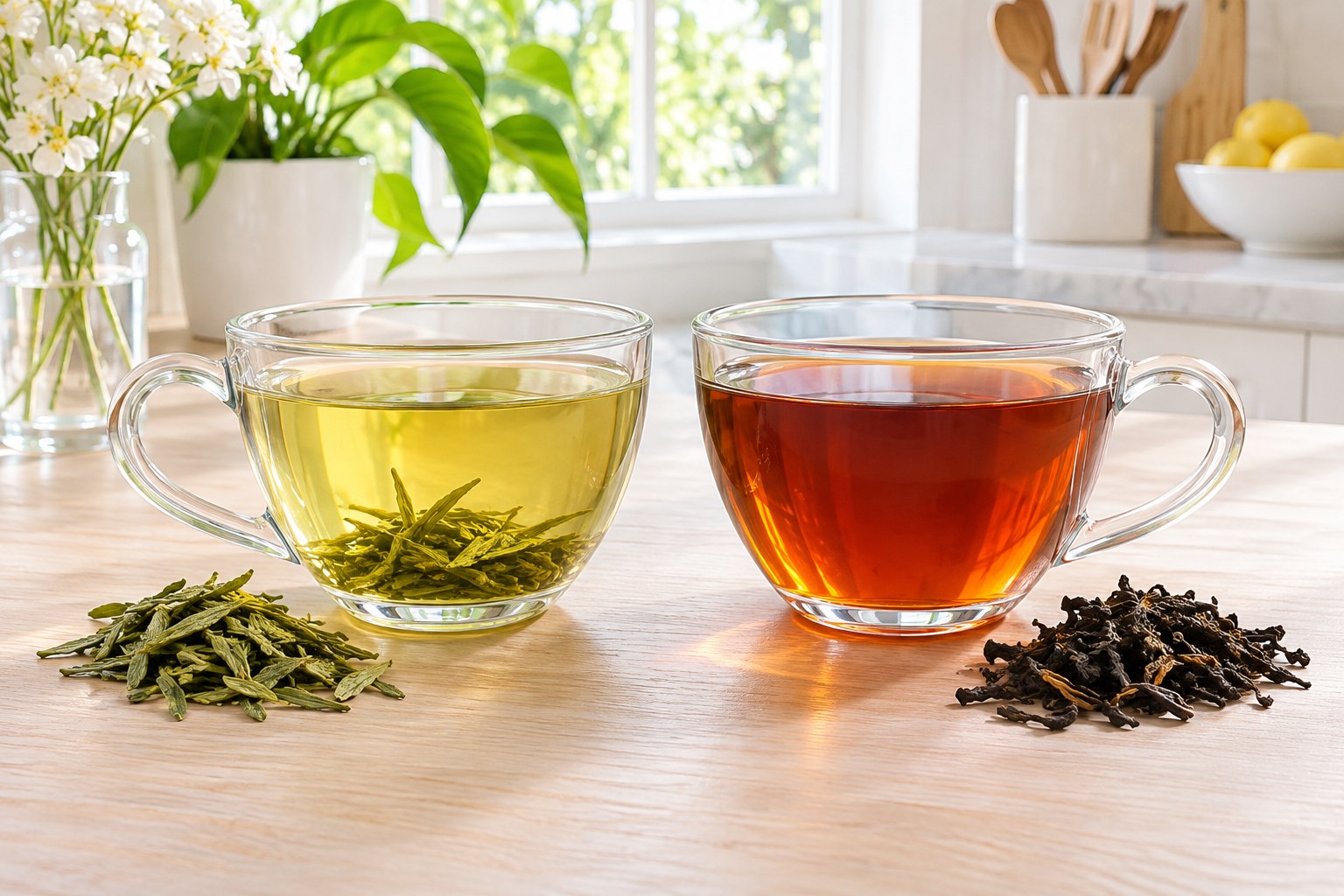
Table of Contents
30-second verdict
Choose a breakfast-style black tea if you want a strong, full-bodied cup that takes milk well and is usually brewed with near-boiling water. Choose green tea if you prefer something lighter and fresher and don’t mind cooler water and a shorter steep. BfR’s approximate reference values put black tea higher in caffeine, but the ranges overlap. The specific tea and preparation matter more than the colour alone.
| What matters | Green tea | Black tea |
|---|---|---|
| Processing | Green teaHeated soon after picking to stop oxidation | Black teaRolled or crushed, then oxidised fully |
| Caffeine, generic guideline (one 200 mL cup) | Green teaAbout 30 mg | Black teaAbout 45 mg |
| Caffeine, one Twinings tea bag in 200 mL | Green tea19 to 45 mg | Black tea40 to 76 mg (unflavoured black) |
| Typical taste | Green teaFresh, vegetal or toasty, lighter body | Black teaMalty, brisk, fuller body |
| Starting brew (loose leaf) | Green tea2 g per 150 mL, about 80°C, 1 to 2 minutes | Black tea2.5 g per 150 mL, 90 to 98°C, 3 to 4 minutes |
Table sources: caffeine guideline values from the German Federal Institute for Risk Assessment (BfR caffeine FAQ, adapted from EFSA); tea-bag ranges from the Twinings US FAQ; starting brews from the Rare Tea Company (leaf amounts) and the UK Tea & Infusions Association (black tea temperature and time, green tea temperature). Your tea’s own pack instructions come first.
Green Tea vs Black Tea: Processing Is the Main Difference
Both teas are made from the leaves of Camellia sinensis. The Tea Association of the USA describes black tea as fully oxidised, and green tea as not oxidised after harvest.
Oxidation starts when the leaf’s cell walls are broken and its natural enzymes react with air, a bit like a cut apple turning brown. For black tea, makers roll or crush the withered leaves to break the cell walls and encourage oxidation, which darkens the leaf and builds a stronger flavour and colour. For green tea, they use heat to stop oxidation early. That step is called fixing, and it is done by pan roasting, traditionally in China, or by steaming, typically in Japan, as described by Food Technology.
You will sometimes see black tea called “fermented”. In tea-making that word usually means oxidation, not fermentation by microbes. Microbial fermentation belongs to a different group, the dark teas, which the Tea Association notes are microbially fermented after manufacture.
Caffeine: Compare the Cup, Not Just the Colour
Green tea is not automatically low in caffeine, and black tea is not automatically high. The amount in your cup depends on the leaf, how much of it you use, the size of the cup and how long and how hot you brew it.
On the same 200 mL cup, the BfR puts black tea at about 45 mg and green tea at about 30 mg, and says all such values are approximations. Twinings gives ranges for one of its tea bags in 200 mL: 19 to 45 mg for green and 40 to 76 mg for unflavoured black. Those two ranges overlap between 40 and 45 mg, which is why a particular green tea can contain as much caffeine as a particular black tea.
Two practical points follow. Using more of the same tea under similar brewing conditions generally increases the caffeine in your cup. Simply adding water to an already brewed cup dilutes it without removing caffeine. And these figures describe brewed leaf tea, not matcha, where you drink the powdered leaf itself. For how tea compares with a cup of coffee, see our guide to caffeine in tea vs coffee.
Taste and Brewing
Taste. Black tea usually tastes maltier and brisker, with more body, which is why it stands up to milk. Green tea is usually lighter. For example, Ippodo describes its sencha in terms of umami, sweetness and astringency, while Rare Tea Company describes a vegetal flavour and nutty finish in its Chinese Longjing. These are examples, not fixed rules: a gently brewed black tea can be smooth rather than bitter, and not every green tea tastes grassy.
A starting point for loose leaf. Use these as a first try, then adjust to taste.
Green tea: about 2 g of leaf per 150 mL of water (Rare Tea Company), water at around 80°C (UK Tea & Infusions Association), steeped for 1 to 2 minutes. Twinings’ brewing guide suggests 2 minutes for green tea.
Black tea: about 2.5 g per 150 mL (Rare Tea Company), water at 90 to 98°C and 3 to 4 minutes (UK Tea & Infusions Association). Twinings gives 3 to 5 minutes.
Leaf amount and mug size are separate decisions. If you brew a larger mug, scale the leaf up with the water. If you keep the same leaf in more water, you get a weaker-tasting cup. Specialist styles can use much more leaf. For example, Ippodo’s basic sencha method uses 10 g of leaf in 210 mL at 80°C for 60 seconds. When the pack gives instructions, follow them.
If your tea tastes bitter, shorten the steep first. Twinings advises a shorter brew for a milder flavour, and the Rare Tea Company notes that longer steeping makes a cup more astringent. With green tea, also check that the water is not boiling. You can also use a little less leaf.
Which Tea Should You Choose?
Think in terms of taste and routine rather than promised effects.
For a morning cup: if you like a strong, milky breakfast tea, black tea is the natural pick. If you prefer something lighter, a green tea works too. Our guide to the best morning tea goes into more options.
For a cup at your desk: green tea brewed lightly can be easy to sip through a work session, while black tea suits people who want a bolder flavour. See our best tea for focus guide for more on matching tea to work routines.
If you are cutting back on coffee: black tea is the closer match in body and works with milk. Green tea is the bigger change in flavour. Our guide to the best tea to replace coffee compares more choices.
Green Tea vs Black Tea FAQ
Which has more caffeine, green or black tea?
BfR’s approximate reference values are about 45 mg for black tea and 30 mg for green tea per 200 mL cup. The ranges overlap, though, so the specific tea, the amount of leaf and the brewing decide the real figure.
Is green tea always healthier than black tea?
Not automatically. NCCIH notes that definite conclusions cannot yet be reached for most proposed uses of green tea. Choose according to your taste and caffeine preferences. If you want to read more about the research on green tea specifically, see our article on green tea benefits.
Can I brew black tea at the same temperature as green tea?
You can, but most guides brew black tea hotter. The UK Tea & Infusions Association suggests 90 to 98°C for black and around 80°C for green. Black tea brewed cooler usually tastes lighter, so you may need a longer steep.
Which should I try if I’m switching from coffee?
Black tea is usually the easier first step because of its fuller body and the way it takes milk. If you want a fresher, lighter drink, try green tea and keep the water off the boil.
Want to compare more drinks side by side? Browse our tea and coffee comparisons, or explore every tea guide in our tea hub.
