
Welcome to Tea or Coffee. Explore our practical guides designed for better focus and steady energy throughout your day.
How to Make Coffee Without a Coffee Maker: 5 Methods That Work
How to Make Coffee Without a Coffee Maker: Quick Answer
Easiest choice if you have a fine sieve: saucepan steep-and-strain.
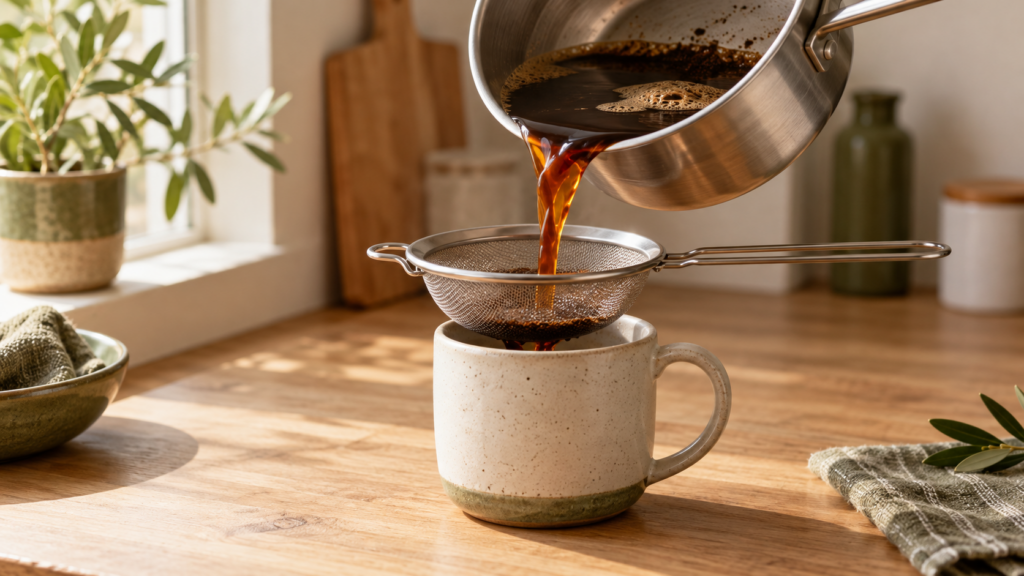
- You need: ground coffee, water, a saucepan, a spoon, a fine sieve and a heat-safe mug. A kitchen scale helps but isn’t essential.
- Starting ratio: 1:16 by weight, for example 20 g of coffee to 320 g of water for one large mug.
- Grind: coarse, similar to what you’d use in a French press.
- Time: a few minutes of active work to heat the water, stir and strain, plus about 4 minutes of steeping as a starting point.
- Result: a full-bodied cup with some fine sediment. It’s a dependable backup, not a copy of what your machine makes.
If your coffee maker is broken, you’re travelling or your kitchen is still in boxes, you can still make a good cup with what’s in the cupboard. This guide on how to make coffee without a coffee maker covers five methods, the gear each one needs and what kind of cup to expect. If you find yourself making coffee this way every day, a simple press is the easiest upgrade; our guide to the best French press compares options.
Table of Contents
Method 1: Saucepan Steep-and-Strain
This is the most forgiving option for most kitchens, because it only needs a pan and a sieve.
What you need: a saucepan, ground coffee, water, a spoon, a fine sieve and a heat-safe mug.
- Heat the water in the saucepan until it boils, then take the pan off the heat.
- Stir in the coffee so all the grounds are wet.
- Leave it to steep for about 4 minutes as a starting point.
- Stir once more, then wait briefly so most of the grounds settle.
- Pour slowly through the fine sieve into your mug, stopping before the last sludgy layer.
What to expect: a rich, full-bodied cup. A sieve lets more fine particles through than a paper filter, so expect some sediment at the bottom of the mug. If it tastes weak, use a little more coffee or steep a bit longer next time; if it’s too strong, add a little hot water.
Method 2: Improvised Pour Over
If you have paper coffee filters but no dripper, you can still brew a cleaner, paper-filtered cup. The key is supporting the filter securely.
What you need: a proper paper coffee filter, a fine-mesh kitchen sieve rated for hot liquids that sits securely on a heat-safe jug or mug, ground coffee, a kettle and a spoon.
Don’t balance a loose paper filter on the rim of a mug or hold it in your hand while you pour hot water. Use only coffee filters suitable for hot brewing; plain paper towels, napkins and printed or scented paper aren’t suitable.
- Set the support firmly on the jug or mug and fit the filter inside it.
- Add the coffee, ground a little finer than for the steeping methods.
- Pour just enough hot water to wet the grounds and wait a few seconds.
- Pour the rest slowly in small stages, keeping the water inside the filter and avoiding overfilling.
- Let it finish draining, then lift the support away carefully.
What to expect: a cleaner cup with less sediment than the sieve methods. Draining time depends on your filter, support and grind, so it won’t match a purpose-made dripper exactly.
Method 3: DIY Coffee Bag
A coffee bag works like a tea bag: the grounds steep in your mug and you lift them out when you’re done.
What you need: a paper coffee filter or another bag made for food contact, a food-safe closure such as food-safe cotton cooking twine rated for hot-food contact, ground coffee, hot water and a mug.
- Put the coffee in the center of the filter, leaving space for the grounds to move.
- Gather the edges and tie them closed securely with the twine.
- Place the bag in the mug and pour hot water over it.
- Steep for about 4 minutes as a starting point, dunking it gently a few times.
- Lift the bag out carefully with a spoon and let it drain over the mug.
Don’t seal the bag with glue, staples or synthetic string that could melt. A tightly packed bag lets water reach the coffee less easily than loose grounds, so it can taste weaker at the same timing. Adjust the steep time or amount of coffee to your taste.
If the filter is too small, tears or cannot close securely, use the loose-ground strainer method instead.
Method 4: Cold Brew in a Jar
This method is not a quick fix for this morning’s coffee, since it needs overnight time and a fridge. It’s useful if you can plan ahead.
What you need: a clean jar or container with a lid, coarse ground coffee, cold water, a sieve and a paper filter if you have one.
- Add the coffee and water to the jar. About Coffee’s cold brew guide uses a concentrate ratio of about 1:4 to 1:5, such as 50 g of coffee to 250 g of water.
- Stir, cover and steep in the refrigerator for about 12 hours as a starting point; taste and adjust the next batch if needed.
- Strain through a sieve, lined with a paper filter for a cleaner result.
- Keep the finished concentrate covered in the fridge.
What to expect: this makes a concentrate, not ready-to-drink coffee, so dilute it with water or milk to taste. You’ll get less liquid than the water you added, because the grounds absorb some of it. If you have a press, you can also make cold brew in a French press, but a jar works fine.
Method 5: Strainer Method
If you have a kettle but don’t want to use the stove, you can steep the coffee in one heat-safe vessel and strain it into another.
What you need: a kettle, a heat-safe jug, teapot or large mug, a second heat-safe mug, a spoon and a fine tea strainer or small sieve.
- Put the coffee in the jug or first mug.
- Pour in hot water from the kettle and stir.
- Steep for about 4 minutes as a starting point.
- Hold the strainer over the second mug and pour slowly.
What to expect: a cup similar to the saucepan method, with some fine particles. Mesh strainers don’t give the clarity of a paper filter, but this is the simplest method if all you have is a kettle.
Ratios and Grind Notes
| Method | Starting ratio (by weight) | Grind | Steep or contact time | Filter |
|---|---|---|---|---|
| Saucepan steep-and-strain | 1:16 | Coarse | About 4 minutes | Fine sieve |
| Improvised pour over | 1:16 | Medium to medium-fine | Varies with filter and support | Paper coffee filter |
| DIY coffee bag | 1:16 | Coarse to medium | About 4 minutes, adjust to taste | Paper filter bag |
| Cold brew in a jar | 1:4 to 1:5 (concentrate) | Coarse | About 12 hours | Sieve, ideally lined with paper |
| Strainer method | 1:16 | Coarse | About 4 minutes | Fine strainer or sieve |
The 1:16 ratio, such as 20 g of coffee to 320 g of water or 30 g to 480 g, is a common hot-brew starting point. REI’s camp coffee guide uses it and recommends weighing rather than assuming a scoop always holds the same amount. The times above are starting points for these improvised methods, not tested recipes.
If you don’t have a scale, use the same spoon each time and adjust the next cup by taste. Our coffee to water ratio guide explains how to change strength, and the coffee grind size guide shows how grind affects each method.
If This Becomes Permanent…
These are useful backup methods. If you’re making coffee this way every day, a French press is a simple, low-maintenance upgrade that uses the same steep-and-separate idea; see the press guide linked near the top of this page. For a concentrated base for milk drinks, see how to make espresso without a machine.
FAQ
Can you make coffee in a microwave?
A microwave can heat water, but a kettle or saucepan is easier to manage. If you use a microwave, follow its manufacturer’s water-heating instructions and use suitable open microwave-safe cookware. Water can become superheated without visibly boiling and may erupt when the cup is moved or coffee is added, causing burns. Do not exceed the manufacturer’s recommended heating time.
Is instant coffee a useful backup?
Yes. Instant coffee only needs hot water, so it’s the quickest option when you have no brewing gear at all. Follow the amount suggested on the jar, or see our guide to the best instant coffee for energy for options.
Conclusion
For most people, the saucepan or strainer method is the quickest way to good coffee without a machine, and an improvised pour over gives a cleaner cup if you have paper filters. Start with a 1:16 ratio and adjust from there. For more ways to brew at home, see our home brewing guide.
