
Welcome to Tea or Coffee. Explore our practical guides designed for better focus and steady energy throughout your day.
How to Make Espresso Without a Machine (3 Espresso-Style Methods)
If you want to know how to make espresso without a machine, the honest answer is that you can get close in strength, not make the same drink. A moka pot, an AeroPress or a French press can each brew a strong coffee base at home in under 10 minutes. This guide shows what each one needs and which suits your drink.
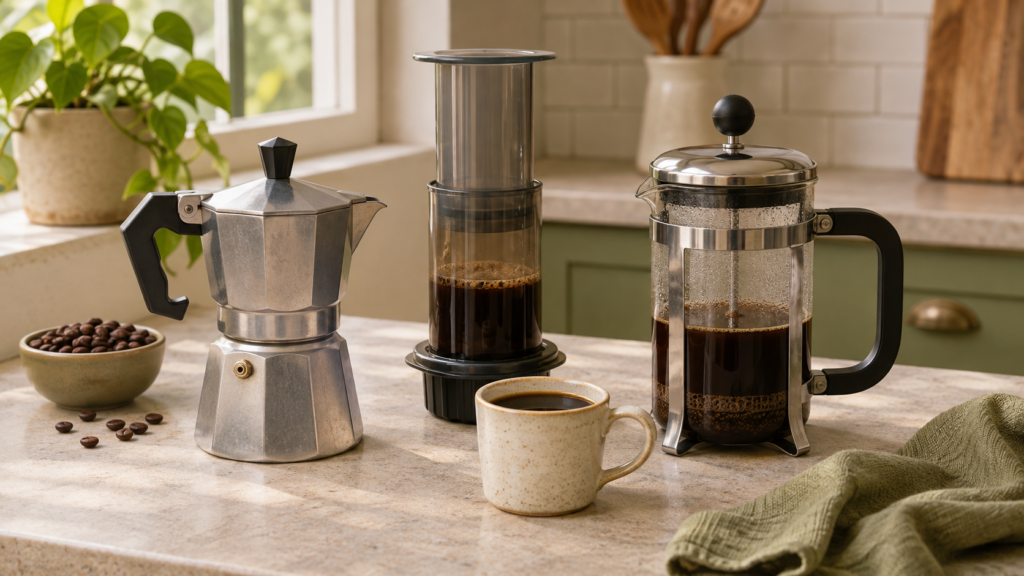
The honest answer: These three tools make concentrated espresso-style coffee, not machine espresso. Espresso comes from forcing hot water through a compact coffee puck at enough pressure, and espresso standards specify about 9 bars, while a moka pot typically brews at 1 to 2 bars. Expect strong coffee rather than real crema, although some purpose-built manual devices, such as lever presses with a pressure gauge, are designed for actual espresso, but a standard AeroPress is not in that category.
Table of Contents
How to Make Espresso Without a Machine: Quick Summary
| Method | Equipment | Dose and water | Grind | Time | Approx. output |
|---|---|---|---|---|---|
| Moka pot | Stovetop moka pot | Water just below the valve; funnel loosely filled | Medium-fine, no tamping | About 3 to 6 minutes | Small servings; volume depends on the model and is not guaranteed |
| AeroPress | AeroPress Original, Go or Clear with Flow Control Filter Cap and stainless steel filter (accessories) | 18 to 22 g coffee, 75 to 80 g water at 190 to 202°F (86 to 95°C) | Fine, but not as fine as espresso | About 2 minutes | A small serving; AeroPress states no yield, and you get less than the water added |
| French press | Any French press, used well below its full capacity | 30 g coffee, 300 ml (10 fl oz) water, as an editorial starting point | Coarse | 5 minutes, plus decanting | Less than the water added, because the grounds hold some back |
Output varies with your coffee, brewer and heat, and none of these is a guaranteed yield.
Method 1: Moka Pot
This is our practical default of the three, a use-case judgment and not proof that it brews the strongest coffee. It needs no paper filters, and its strong coffee suits milk drinks. The steps below follow Bialetti’s Moka Express directions, so check your own model’s manual as well.
- Fill the base with water to just below the safety valve. Never modify or block the valve.
- Insert the funnel and fill it loosely with medium-fine moka grind. Do not tamp it, and do not use an espresso-fine puck.
- Screw the top on firmly, without using the handle for leverage.
- Set the pot on low to medium heat, and keep any gas flame from climbing the sides.
- Remove it from the heat as soon as the coffee is through, usually after about 3 to 6 minutes depending on size and heat.
There is no single gram figure, because funnels differ by pot size. The “cups” on a moka pot mean small servings, not US mugs, and the volume depends on the model, so the label is not a guaranteed yield. The standard aluminum Moka Express is not suitable for induction, and that does not apply to every Bialetti model.
When to Just Get the Machine
You do not need to own a machine to enjoy these methods. A machine starts to make sense if you want actual espresso with crema, or you make several milk drinks a day and want a shot in the same format each time. In that case, our guide to the best espresso machine for home is the next step.
Method 2: Manual Pressure Brewer (AeroPress-Style)
This method follows AeroPress’s own espresso-style recipe. It works with an AeroPress Original, Go or Clear, and it requires the Flow Control Filter Cap and a stainless steel filter, so check what came with your brewer. If you have only the stock cap and paper filter, use the standard instructions.
- Heat water to 190 to 202°F (86 to 95°C). Put the stainless steel filter in the Flow Control Filter Cap and attach the cap to the chamber.
- Set it on a sturdy mug, then add 18 to 22 g of coffee, ground fine but not as fine as espresso, and shake to level it.
- Add 75 to 80 g of hot water and stir well.
- Let it brew for 30 seconds.
- Insert the plunger and press slowly and smoothly. When you hear a hiss, press faster to the bottom.
AeroPress’s standard instructions warn against pushing too hard, so if the plunger resists, ease off rather than forcing it. Let the cap cool or use a cloth, because it gets hot. AeroPress says its brewers cannot make true espresso and that the Flow Control cap will not reach 9 bars, so do not try inverted methods or add-on pressure attachments here.
Method 3: French Press Concentrate
As an editorial starting point, not a maker-tested recipe, use 30 g of coarse-ground coffee to 300 ml (10 fl oz) of hot water, steep for 5 minutes, press slowly and pour the coffee off straight away so it stops brewing. Our 1:10 ratio goes beyond the 1:12 to 1:13 Espro lists for a strong French press cup. Keep the grind coarse, since fine grounds can slip past the filter and leave grit.
Do not use espresso-fine coffee or force the plunger, because a French press has no way to build espresso pressure, and pressing hard can spill hot coffee. Expect a strong, heavier cup with no crema. Our guide to espresso in a French press covers the full recipe.
Which Method for Which Drink
Straight: Choose a moka pot or AeroPress, and serve it in a small cup. Neither is espresso, so sip it as strong coffee.
Milk drinks: Our guide on how to make a latte at home uses 1 part strong coffee to 1.5 parts milk in its no-machine version. Do not apply machine-espresso ratios here, because this coffee is weaker. To froth milk in a French press, follow that guide.
Iced: The French press suits iced drinks because it makes more coffee at once. Pour cooled coffee over ice in a sturdy glass, and expect melting ice to dilute it.
Added water and brewed yield are different things. You add 75 to 80 g of water to the AeroPress but get less back, and topping up with hot water afterward raises the volume while weakening the cup.
Troubleshooting
Change one variable at a time, and stay within your brewer’s instructions.
- Weak: Use a little less water in the AeroPress or French press, or extend the steep slightly. In a moka pot, check that the funnel is full and level.
- Sour: Use a slightly finer grind within that method’s range, or brew a little longer.
- Bitter: Bialetti links bitterness to overfilling and full heat, so lower the heat and remove the pot promptly. In other brewers, shorten the brew or use a slightly coarser grind.
- Silty: Use a coarser grind in the French press, and leave the last of the coffee behind when you pour.
FAQ
Can you get real espresso or crema without a machine?
Not from these three tools. A moka pot, a standard AeroPress and a French press do not reach espresso brewing pressure through a compact puck, so any foam on top is not the same as espresso crema. A purpose-built manual espresso device is the route to actual espresso without an electric machine.
Can you use pre-ground coffee?
Yes, if the grind suits the method. AeroPress’s espresso-style recipe needs coffee that is fine but not as fine as espresso, a moka pot needs medium-fine, and a French press needs coarse. Pre-ground espresso coffee is usually too fine for a French press.
What is the strongest practical choice?
For most kitchens, a moka pot is the practical default, because it brews strong coffee with no accessories. That is our use-case judgment and not proof that it is the strongest of these three recipes. Strength depends on your coffee, dose and brewer.
Start with the tool you already own, and change one variable at a time until the cup suits you. For more brewing methods and basics, visit our home brewing guide.
