
Welcome to Tea or Coffee. Explore our practical guides designed for better focus and steady energy throughout your day.
How to Make a Latte at Home (Hot + Iced)
Learning how to make a latte at home comes down to one double shot of espresso, properly steamed milk and a cup of the right size. This recipe gives exact amounts for a hot latte, then covers a no-machine method, an iced version and a simple ratio chart.
Find your home latte setup
Tell us what you have in the kitchen. We’ll show you how to make a latte with it and when an upgrade might help.
Find your favorite latte ratio
Compare two small samples before making a full cup. These are starting points for your own coffee, not a fixed rule.
- Brew one batch of coffee using your chosen method. Divide it between two cups using the amounts below.
- Add warm, unfrothed milk from the same jug. Skip sugar and syrup for this comparison.
| Sample | Coffee | Milk |
|---|---|---|
| A | ||
| B |
Here, 1 tbsp means a 15 ml measuring spoon. Use the ml amounts if your spoon is a different size.
Stir both samples and let them cool to a comfortable sipping temperature. Taste each. Which would you choose again?
Recipe card
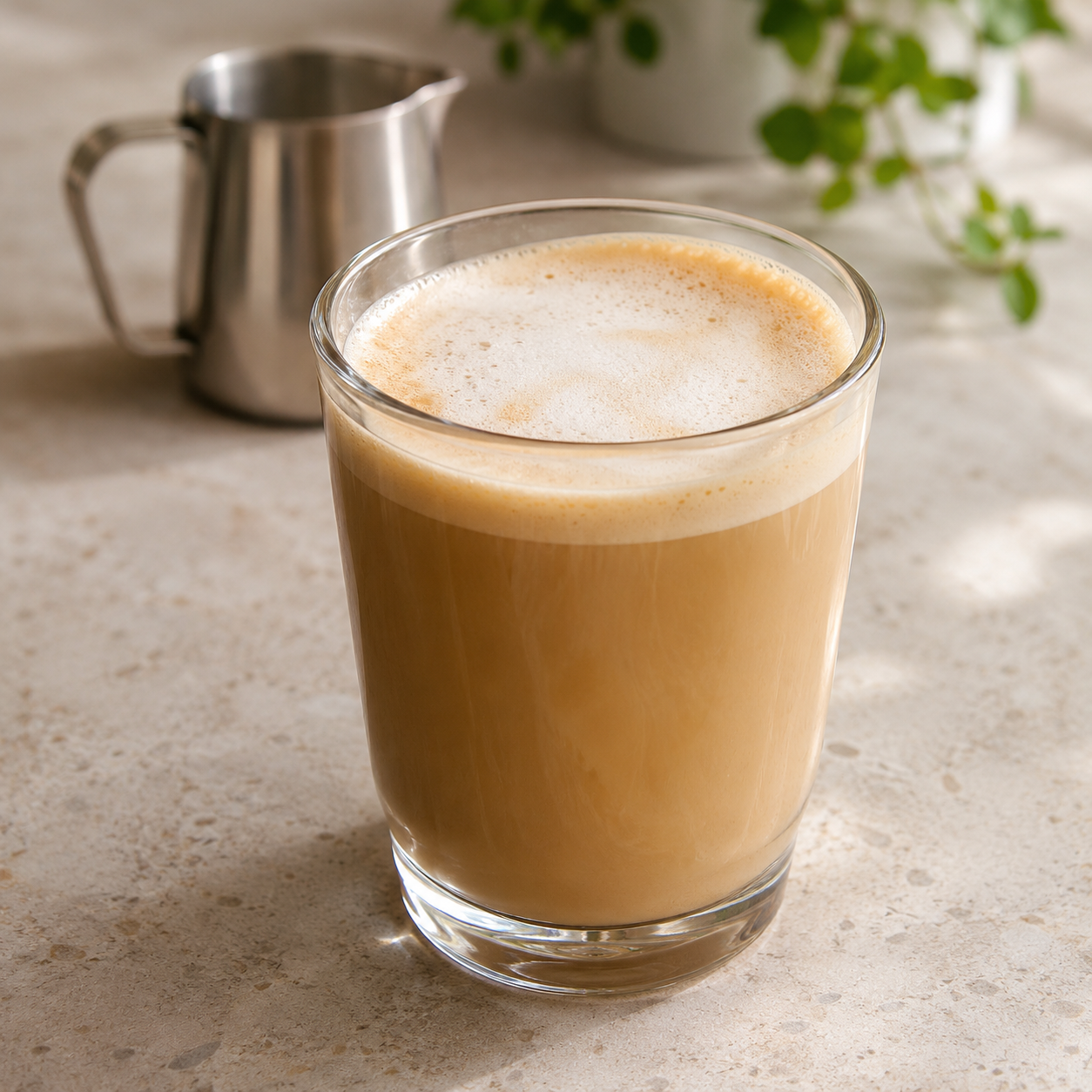
Latte at Home
A homemade latte made with espresso or strong coffee and milk, with simple options for serving it hot or iced.
Ingredients
Method
- Get set up. Heat the machine as its manual directs, then pour 6 fl oz (180 ml) of cold milk into a jug, keeping it below the spout. Cold milk gives you more time to add air before it gets hot.
- Pull the espresso. Brew a 1.5 fl oz (45 ml) double shot into a 10 fl oz (300 ml) cup. A common starting point by weight is 36 to 40 g of espresso from 18 to 20 g of ground coffee. This is not an exact conversion to 45 ml: crema changes the measured volume.
- Position the wand. Purge the wand to clear any water, then place the tip 1 to 2 cm (about 1/2 inch) into the milk and turn on the steam.
- Add air, then heat. Lower the jug slowly until the tip sits at the surface, which adds air to the milk. Then raise the jug slightly so the milk spins in a whirlpool, because texture comes first and temperature second.
- Stop at the right temperature. Watch the thermometer and stop at 140 to 150°F (60 to 66°C). Turn the steam off before you lift the wand out so it cannot spray hot milk, then wipe the wand with a damp cloth and purge it briefly.
- Pour. Tap the jug on the counter to remove large bubbles, then swirl it until the milk looks glossy. Pour steadily into the center of the espresso until the drink has a thin layer of microfoam on top.
Notes
Equipment: espresso machine with a steam wand, milk jug, thermometer.
Approximately 1 part espresso to 4 parts milk by volume, with milk measured before frothing. Milk temperature: 140 to 150°F (60 to 66°C). Use a 10 fl oz (300 ml) cup.
Finished yield: about 8 fl oz (240 ml), including 7.5 fl oz (225 ml) of liquid plus the small amount of volume foam adds. Metric amounts are rounded at 30 ml per fluid ounce.
Total time is about 5 minutes, plus machine heat-up. Follow your own machine’s manual for operation and cleaning.
Metric amounts are rounded at 30 ml per fluid ounce.
Table of Contents
How to Make a Latte at Home: Step-by-Step
These steps are for a machine with a steam wand. Follow your own machine’s manual for operation and cleaning, because controls differ between models.
- Get set up. Heat the machine as its manual directs, then pour 6 fl oz (180 ml) of cold milk into a jug, keeping it below the spout. Cold milk gives you more time to add air before it gets hot.
- Pull the espresso. Brew a 1.5 fl oz (45 ml) double shot into a 10 fl oz (300 ml) cup. A common starting point by weight is 36 to 40 g of espresso from 18 to 20 g of ground coffee. This is not an exact conversion to 45 ml: crema changes the measured volume.
- Position the wand. Purge the wand to clear any water, then place the tip 1 to 2 cm (about 1/2 inch) into the milk and turn on the steam.
- Add air, then heat. Lower the jug slowly until the tip sits at the surface, which adds air to the milk. Then raise the jug slightly so the milk spins in a whirlpool, because texture comes first and temperature second.
- Stop at the right temperature. Watch the thermometer and stop at 140 to 150°F (60 to 66°C). Turn the steam off before you lift the wand out so it cannot spray hot milk, then wipe the wand with a damp cloth and purge it briefly.
- Pour. Tap the jug on the counter to remove large bubbles, then swirl it until the milk looks glossy. Pour steadily into the center of the espresso until the drink has a thin layer of microfoam on top.
An automatic milk system works differently from a steam wand. A latte machine with a built-in milk system runs its own cycle, so the wand position and thermometer steps above do not apply. Use its latte program, and follow its manual for cleaning the milk path.
No-machine version
This version makes a strong-coffee latte, not an espresso latte. Our guide to espresso without a machine compares moka pot, AeroPress and French press methods for this version, but the result differs from machine-brewed espresso. Because strong brewed coffee is less concentrated than espresso, this recipe uses a ratio of 1 part coffee to 1.5 parts milk.
- Brew the coffee. In an AeroPress or French press, make 4 fl oz (120 ml) of strong coffee from 15 g of ground coffee and 5 fl oz (150 ml) of hot water, because the grounds hold some water back. With a moka pot, follow its fill lines and measure out 4 fl oz (120 ml).
- Warm the milk. Heat 6 fl oz (180 ml) of cold milk in a small saucepan to 140 to 150°F (60 to 66°C), checking with a thermometer.
- Froth and pour. Froth milk in a French press, then pour it into the coffee in a 12 fl oz (360 ml) mug. You will have about 10 fl oz (300 ml) of liquid, plus foam.
Latte ratios explained
Latte ratios describe how much milk goes with each shot of espresso, and no single universal standard exists. Cafes vary, so treat the chart below as practical starting points. Each drink starts with the same double shot, and the main differences are the amount of milk and the depth of the foam.
| Drink | Espresso | Liquid milk before frothing | Espresso to milk | Foam layer | Approx. finished drink |
|---|---|---|---|---|---|
| Latte | 1.5 fl oz (45 ml) | 6 fl oz (180 ml) | 1:4 | About 0.2 in (5 mm) | 8 fl oz (240 ml) |
| Cappuccino | 1.5 fl oz (45 ml) | 3.5 fl oz (105 ml) | About 1:2.3 | At least 0.4 in (10 mm) | 6 fl oz (180 ml) |
| Flat white | 1.5 fl oz (45 ml) | 3.5 fl oz (105 ml) | About 1:2.3 | About 0.2 in (5 mm) | 5.5 fl oz (165 ml) |
Foam is made from the milk in the third column, so do not add it as a separate ingredient. Deeper foam adds more volume, which is why the cappuccino finishes larger than the flat white from the same liquid.
For the differences in milk, texture and taste, see our latte, mocha, flat white and macchiato comparison.
Variations
Iced latte
Fill a sturdy 16 fl oz (480 ml) glass with 1 cup of ice, then add 6 fl oz (180 ml) of cold milk. Brew a 1.5 fl oz (45 ml) double shot into a small heat-safe cup and pour it slowly over the milk and ice, so hot coffee never lands on bare cold glass. This keeps the 1:4 ratio and gives about 7.5 fl oz (225 ml) of drink before the ice melts.
Without an espresso machine, replace the shot with 4 fl oz (120 ml) of strong brewed coffee and use a 20 fl oz (600 ml) glass to leave room for the extra coffee and ice.
For a layered café-style variation, follow our iced macchiato recipe, then stir before drinking.
Vanilla latte
Stir 2 teaspoons (10 ml) of vanilla syrup into the espresso before adding the milk, then adjust to taste. The same amount works in the iced version. For the full method and homemade syrup, follow our vanilla latte recipe.
For a spiced tea-and-coffee variation, try our dirty chai latte, which combines chai, espresso and milk.
The right ingredients
Use a coffee you already enjoy, ground just before brewing if you can. Our guide to the best milk for lattes compares dairy and plant options. Whole milk is a simple place to start, and Breville suggests practicing with the same type and brand of milk for consistency. If you would rather skip the wand work, our latte machine guide compares automatic options.
FAQ
What is the best ratio for a latte?
Start with 1 part espresso to 4 parts milk by volume, measured before frothing. That means 1.5 fl oz (45 ml) of espresso to 6 fl oz (180 ml) of milk. Use more or less milk to suit your taste.
What temperature should milk be for a latte?
Aim for 140 to 150°F (60 to 66°C), and use a thermometer until you know how your jug feels at that point. Start with cold milk so you have time to add air first.
Can you make a latte without an espresso machine?
Yes, you can make a similar drink with 4 fl oz (120 ml) of strong brewed coffee and 6 fl oz (180 ml) of frothed milk. These methods make strong coffee with a different concentration and texture from machine-brewed espresso.
Once the 1:4 ratio feels routine, adjust the milk and foam to suit your cup. For more methods and gear basics, visit our home brewing hub.
