
Welcome to Tea or Coffee. Explore our practical guides designed for better focus and steady energy throughout your day.
How to Froth Milk in a French Press (Barista Foam, No Machine)
You can froth milk in a French press with nothing more than warm milk and the plunger. Pumping the mesh filter up and down pulls air into the milk and turns it into a thick, pourable foam for lattes and matcha lattes.
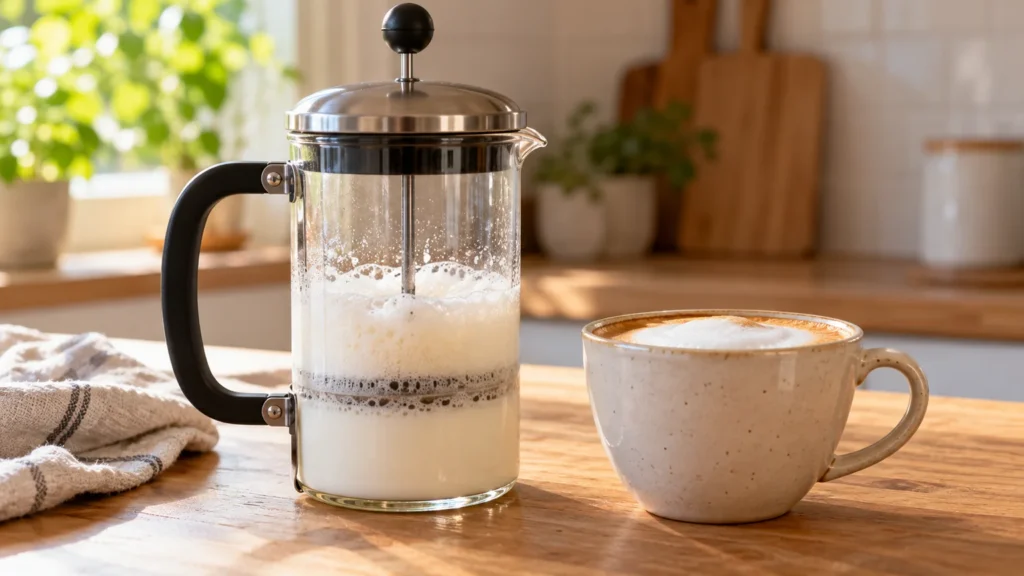
Quick Method
How to Froth Milk in a French Press: Quick Method
Temperature: heat the milk separately to about 60 °C (140 °F), checked with a kitchen thermometer. Don’t let it boil.
Amount and headroom: leave room for the milk to double. As a starting point, fill no more than about one-third of the press, with enough milk to cover the filter at the bottom of each stroke.
Pumping: no fixed stroke count. Start with slow, controlled strokes, speed up gradually, and pump for about 30 seconds or until the volume has roughly doubled.
Finish: swirl gently and pour right away.
Time: the frothing itself takes under a minute once the milk is warm. Heating the milk and washing up take extra time.
Table of Contents
Step-by-Step: Heat, Fill, Pump, Swirl, Pour
The method follows the same basic steps as the coffee-press guide from Starbucks at Home: warm the milk, leave room for it to grow, then raise and lower the plunger. The notes below add the details that help it work in an ordinary press.
1. Heat the milk to about 60 °C (140 °F)
Warm the milk in a small saucepan or a microwave-safe container, stirring now and then. Check it with a kitchen thermometer and stop at about 60 °C (140 °F), well before it boils. This is a target for texture and taste, not a food-safety step, and it doesn’t tell you the drink is at a comfortable sipping temperature.
Heat the milk in its own container, not in the press. A standard French press shouldn’t go on the stove or in the microwave unless its manufacturer says it can.
2. Pour the milk into the press and leave headroom
The milk grows as it fills with air, and Starbucks at Home advises leaving space for it to double. A conservative starting point is to fill no more than about one-third of the press, so the foam has room to rise without reaching the lid.
There also needs to be enough milk to cover the mesh filter when the plunger is at the bottom of its stroke. For example, about 100 ml in a 350 ml press is roughly one-third full, as long as it covers the filter in your model and stays within the maker’s fill guidance. If it doesn’t, a smaller press is the better tool for a single drink.
3. Pump for about 30 seconds
Put the lid on with the plunger raised, hold the lid in place with one hand, and keep the press on a steady surface. Start with short, controlled strokes, then gradually increase the pace while keeping the filter under the milk.
There is no single correct number of strokes. Pump for about 30 seconds, watch the volume and texture, and stop when the milk has roughly doubled and looks thick and creamy.
If the plunger meets strong resistance, ease off rather than forcing it. Don’t pump so hard that hot milk sprays out of the spout.
4. Swirl gently
Lift out the plunger and swirl the press gently to even out the foam. If a few larger bubbles sit on top, you can give the press a light tap on a folded kitchen towel, but this step is optional. Never knock a glass press against a hard counter.
5. Pour straight away
Pour soon after frothing, while the foam is at its thickest. To build a layered drink, hold back the foam with a spoon, pour the warmer milk underneath first, then spoon the foam on top.
Afterwards, rinse the plunger and wash the press and filter following the manufacturer’s care instructions, so milk doesn’t dry in the mesh. This method may not suit every press, such as one with a multi-layer filter or a chipped or cracked glass beaker, and the maker’s instructions always come first.
Which Milks Froth Best
There’s no single winner. Nespresso’s guidance for its own milk frothers suggests that whole milk gives a creamier foam, while lower-fat and skimmed milk give a lighter, airier foam. Plant milks vary more, and barista versions made for frothing are a sensible first choice.
That advice comes from dedicated frothers rather than from frothing milk in a French press, so results in a press can differ by brand, recipe and technique. If one milk gives thin foam, try another before giving up on the method.
Choosing milk for specific drinks is a bigger topic, and we will cover it in a separate guide to the best milk for lattes.
Troubleshooting: Thin Foam, Big Bubbles and Cold Foam
Most problems come down to temperature, headroom or how the plunger moves. Check these before changing anything else.
The foam is thin. Confirm the milk is close to 60 °C with a thermometer, pump a little longer, and keep the filter under the milk. If it still won’t thicken, try a different milk, since results vary between types and brands.
There are big bubbles. Finish with a gentle swirl. If larger bubbles remain, try shorter, more controlled strokes on your next attempt.
Milk escapes from the lid or spout. Use less milk so there is more headroom, slow your strokes, and keep a firm hand on the lid.
The foam drops quickly. Foam stability varies with the milk and the technique. Froth last, once your coffee or matcha is ready, and pour right away.
Cold foam variant
You can also try frothing cold milk straight from the fridge. Skip the heating step and use the same headroom and pumping technique.
Results vary more than with warm milk. In a documented home trial published by Better Brew, cold milk frothed less than warm milk, so treat this as an experiment for iced drinks rather than a copy of café-style cold foam.
What to Make with It
Once you can froth milk with French press technique, a few easy drinks open up. Pour warm frothed milk over strong coffee for a simple latte-style drink at home; follow our full recipe for how to make a latte at home.
For a smaller, stronger drink, spoon the thicker foam over a short cup of coffee for a cappuccino-style finish. Frothed milk is also the finishing touch for a matcha latte.
FAQ
Cold milk or hot?
Warm milk at about 60 °C (140 °F) is the standard approach and the one used in the Starbucks at Home guide. Cold milk can froth too, but the results are less predictable, so treat it as an experiment for iced drinks.
Does plant milk work?
It can, but results vary by brand and formulation. Barista versions made for frothing are a reasonable first choice, and trying one or two options is the most reliable way to find what works in your press.
How long does the foam last?
Not long, so use it promptly. Stability varies with the milk and technique, which is why it helps to froth last, once your coffee or matcha is ready.
One More Job for Your French Press
A French press can make a thick, pourable milk foam with no extra equipment: warm the milk to about 60 °C, leave plenty of headroom, pump for about 30 seconds and pour right away. It won’t recreate the fine microfoam of a café steam wand, but it is an easy way to make latte-style drinks at home.
If your press is too small for frothing or you’re thinking about a replacement, see our guide to the best French press. For more ways to make good drinks at home, start with our home brewing guide.
