
Welcome to Tea or Coffee. Explore our practical guides designed for better focus and steady energy throughout your day.
Latte vs Mocha vs Flat White vs Macchiato: Every Milk Drink Explained
Latte vs mocha vs flat white vs macchiato comes down to two questions: how much milk goes in, and whether chocolate joins the espresso. A latte is mild and milk-forward, a mocha is a latte with chocolate, a flat white uses less milk for a stronger coffee taste, and a traditional macchiato is espresso with just a spoonful of foam. The chart below puts them side by side, and the sections after it help you choose and make each one.
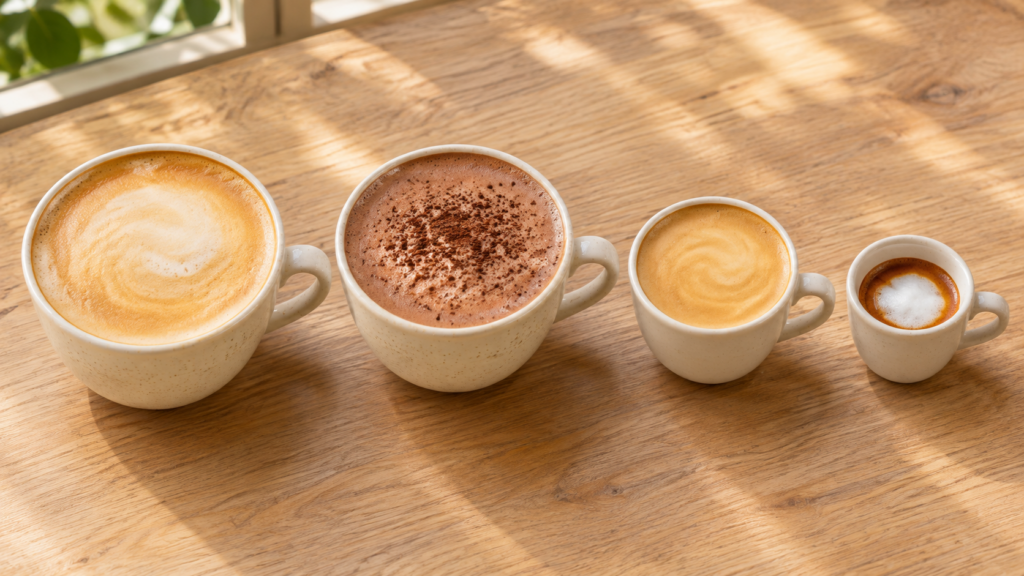
The One-Chart Answer
For comparison, each drink uses one double espresso, shown here as about 1.5 fl oz (45 ml), matching our latte guide. This is a home example, not a definition of a double shot: crema changes volume, so weigh espresso for repeatability. Café recipes and cup sizes vary.
| Drink | Espresso | Liquid milk before frothing | Milk texture | Taste and who it suits |
|---|---|---|---|---|
| Latte | 1.5 fl oz (45 ml) | 6 fl oz (180 ml) | Steamed milk with thin microfoam, about 5 mm | Mild, milky and smooth. Order it if you like coffee softened by plenty of milk. |
| Mocha | 1.5 fl oz (45 ml) | 6 fl oz (180 ml), plus chocolate to taste | As a latte; whipped cream is an optional topping | Chocolatey, and as sweet as the chocolate and any sugar make it. Order it if you want coffee and chocolate in one cup. |
| Flat white | 1.5 fl oz (45 ml) | 3.5 fl oz (105 ml) | Silky microfoam, about 5 mm | Smaller and more coffee-forward. Order it if a latte tastes too milky. |
| Macchiato (espresso macchiato) | 1.5 fl oz (45 ml) | A small spoonful of milk or foam | A dollop of foam on top | Bold and close to straight espresso. Order it if you want espresso with the edge softened. |
Table of Contents
Latte
A caffè latte is espresso with a generous amount of steamed milk and a thin layer of foam on top. Breville describes it as espresso shots and steamed milk topped by a thin layer of milk foam. With plenty of milk, it tastes mild and creamy, which makes it an easy first choice among these coffee drinks.
Make it at home: pull a double shot, steam 6 fl oz (180 ml) of milk until it is glossy with only a little foam, and pour the milk into the espresso.
Mocha
A mocha, also called a caffè mocha or mocha latte, is a latte with chocolate added. Breville’s mocha guide notes that the chocolate usually comes from cocoa powder, chocolate syrup or both, and suggests sugar if you use unsweetened cocoa. Whipped cream on top is optional, and the chocolate turns the drink richer and more dessert-like.
Make it at home: stir chocolate syrup or cocoa into the hot espresso until smoothly mixed, then add the steamed milk as for a latte.
Flat White
A flat white is espresso with a smaller amount of silky, finely textured milk. NESCAFÉ describes it as micro-foamed milk poured over a single or double shot. Because the drink is more compact, the coffee-to-milk ratio is higher than in a latte.
It tastes noticeably more coffee-forward than a latte, though recipes differ from café to café.
Make it at home: use the same double shot with less milk, aiming for our roughly 5.5 fl oz (165 ml) finished cup. Follow your machine’s minimum jug fill; you may need to steam extra milk and pour only what the cup needs.
Macchiato
A traditional espresso macchiato is a shot of espresso “marked” with a small amount of milk foam. Breville notes that macchiato translates to “marked” or “stained” in Italian, and it is usually served in a small cup. Of the four drinks here, it tastes the most like straight espresso.
Two other drinks share the name: a latte macchiato is much milkier and, as Breville puts it, more similar to a latte, while a caramel macchiato is a sweet vanilla and caramel milk drink popularized by coffee chains (see the FAQ below).
Make it at home: pull your espresso into a small cup and spoon a little frothed milk or foam on top.
For the tall, milk-first iced version, try our layered iced macchiato recipe.
Latte vs Mocha
The mocha and latte difference is chocolate. Start with a latte, add chocolate, and you have a mocha, so the espresso and milk can be identical. That one addition shifts the drink from mild and milky to rich and dessert-like.
Sweetness is where the two can really part ways, but it depends on what you add. Chocolate syrup and sweetened cocoa mixes bring sugar with them, while unsweetened cocoa powder adds chocolate flavor without sweetness. A latte can be just as sweet as a mocha if you add syrup to it.
Texture is similar in both, although whipped cream, if you add it, makes a mocha richer still.
So which should you order, a mocha or a latte? Choose the latte when you want the coffee and milk to speak for themselves, or when you plan to add your own flavor. Choose the mocha when you want something closer to a treat.
Latte vs Flat White
The main difference between a café latte and a flat white is the amount of milk. In our home reference, both use the same 1.5 fl oz (45 ml) double shot, but the latte gets 6 fl oz (180 ml) of milk and the flat white gets 3.5 fl oz (105 ml). With less milk around the same espresso, the flat white tastes more concentrated.
NESCAFÉ makes the same point: the espresso in a flat white tastes stronger than in a latte, even though the same amount is used. That’s a difference in taste, not a promise of more caffeine.
Both drinks can use silky microfoam, and in our home reference both have a similar thin layer, about 5 mm. Some cafés use shorter shots for a flat white, but that isn’t universal.
Flat white or latte, then? If you like to taste the coffee clearly, try the flat white. If you prefer a bigger, gentler cup that lasts longer, the latte is the better match.
Ratios Side by Side
The ratios behind the chart explain why the drinks taste so different. A latte uses about 1 part espresso to 4 parts milk by volume. A flat white uses about 1 part espresso to 2.3 parts milk, which is why the coffee comes through more clearly.
Those milk amounts are measured before frothing. Steaming adds air to that same milk, which creates the foam and makes the finished drink larger than the liquids you started with. In our reference, a latte finishes at about 8 fl oz (240 ml) and a flat white at about 5.5 fl oz (165 ml).
A mocha follows the latte ratio, plus chocolate to taste, so its final volume depends on how much chocolate you use. A macchiato has no fixed measured ratio here, just a spoonful of milk or foam on the espresso.
For repeatable espresso, use a scale. A common starting point is a 1:2 brew ratio by weight: 18 g of coffee yielding 36 g of espresso, adjusted for your beans and basket. This grounds-to-espresso ratio is separate from the espresso-to-milk ratios above; it is not an exact conversion to 45 ml.
Making Them at Home
One espresso and milk setup covers the whole chart. For the full step-by-step method, follow our guide on how to make a latte at home.
The bigger choice is how you want to handle the milk. A steam wand gives you the most control over texture, which helps when you want silky microfoam for a flat white or just a spoonful of foam for a macchiato. Our guide to the best espresso machine for home covers machines for people who want to learn that hands-on workflow.
If you’d rather press a button, a machine with automatic milk preparation does the frothing for you. Our latte machine guide compares models built for one-touch milk drinks. Keep in mind that a “flat white” or “macchiato” button follows that maker’s recipe, which may not match a particular café’s version, so check the drink sizes and adjust the milk if the machine allows it.
FAQ
Which of these drinks has the most caffeine?
With the same espresso dose, they’re close, because adding milk doesn’t remove caffeine; it only changes how strong the coffee tastes. A mocha can add a little more, because chocolate contains some caffeine, with dark chocolate containing more than milk chocolate. In cafés, the number of shots matters most, so ask how many shots go into the size you order.
Is a macchiato the same as a caramel macchiato?
No. A traditional macchiato is espresso with a dab of foam. De’Longhi’s caramel macchiato layers vanilla syrup, frothed milk and espresso, then adds caramel sauce. That makes it a sweet milk drink, much closer to a flavored latte.
Can I make these drinks without an espresso machine?
You can make similar milk drinks with strong brewed coffee in place of espresso, such as 4 fl oz (120 ml) of strong coffee with 6 fl oz (180 ml) of milk for a latte-style cup. It won’t be pressure-brewed espresso, so taste and body will differ; the latte guide linked above covers the method.
Want to compare more drinks and brewing methods? Browse our coffee comparisons, or explore the rest of our home brewing guide.
