
Welcome to Tea or Coffee. Explore our practical guides designed for better focus and steady energy throughout your day.
French Press vs Drip Coffee: Which Daily Brewer Wins?
A practical look at French press and automatic drip coffee, with clear picks for busy mornings, shared pots and fuller cups.
French press vs drip coffee is less about which brewer is better and more about how you want your mornings to run. Here, French press means a standard metal-mesh press, and drip means an automatic filter coffee maker with a paper filter, not manual pour over or a recirculating percolator. A reusable metal filter in a drip machine changes part of this picture, which the FAQ covers. If you meant a percolator, see our electric coffee percolator picks instead.
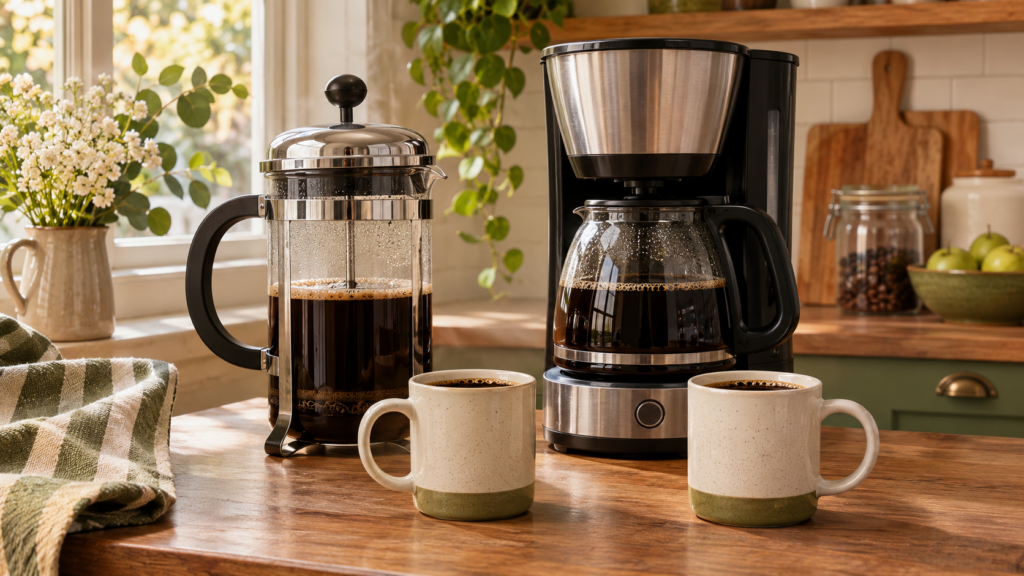
Table of Contents
The 30-Second Verdict
- Getting out the door on a weekday? Drip. You set it up, press a button and walk away.
- Want a fuller, heavier cup? French press, as long as a little sediment does not bother you.
- Making coffee for a household? Drip, because the machine does the work for you, though a large press can serve several people too.
- Drinking a cup or two and short on counter space? French press. It needs only a kettle and a small corner.
- Already happy with your drip machine? Keep it. Add a press only if you want a different texture, not because it is an automatic upgrade.
If a press sounds like the right fit, our guide to the best French press compares the options.
Side-by-Side Comparison
| Factor | French press (metal mesh) | Automatic drip (paper filter) |
|---|---|---|
| Taste and body | Fuller body, some sediment | Cleaner, lighter-feeling cup, little sediment |
| Daily effort | Heat water, steep, press and pour off | Add water, filter and coffee, then press a button |
| Time | About 4 minutes of steeping, plus heating water and cleanup | Varies by machine and batch; mostly hands-off |
| Batch convenience | Depends on the press; a large one can fill several cups in one brew | Depends on the machine; many suit shared pots, and single-cup machines exist |
| Cleanup | Wet grounds to scoop out, plus plunger parts to wash | Lift out the filter; carafe washing and descaling as the maker recommends |
| Startup and running cost | Press and a way to heat water; no paper filters | Little extra if you own a machine; paper filters unless it has a reusable basket |
| Consistency | Few steps, tolerant of small slips | The machine repeats the routine, though results depend on the machine, grind and dose |
French Press vs Drip Coffee: Taste and Body
The filter accounts for most of the difference you notice in the cup. A French press is an immersion brewer, so the grounds steep in all of the water before a metal mesh holds them back. Mesh lets more fine particles and coffee oils through than paper, which is why the cup usually has a fuller body and a little sediment at the bottom.
A paper filter in a drip machine catches more of those, as the National Coffee Association explains when comparing filters. The result is usually cleaner and lighter on the palate, which is a difference in style rather than quality. Your coffee, recipe and machine can all move the result, so a good drip machine with fresh beans can easily beat a careless press.
Pick the French press if you like a coffee with weight to it. Stay with drip if sediment puts you off. If a clean cup interests you but you would rather brew by hand, our French press vs pour over comparison covers that route.
Ease, Time and Consistency
Steep time is not the same as the whole routine. Our guide on how to make French press coffee uses about four minutes of steeping, but you also heat the water, add the coffee, press, pour off and clean up. None of those steps is hard, though you do need to come back to the press when the timer ends, because coffee left sitting on the grounds keeps steeping.
Drip asks for less of your attention. Brew time varies with the machine and the size of the batch, so we would not call either method faster in every kitchen. What matters on a busy morning is that once you press the button, you can shower, pack lunches or answer email while the machine works.
Both methods are fairly repeatable. A press has few steps and all the grounds steep for the same time, so small slips matter less, while a drip machine repeats the same routine for you. That convenience does not guarantee good extraction, since the machine, grind and dose still have to be right.
For the least attention, choose drip. If you are happy to be nearby for a few minutes and want more say over the steep, the French press gives you that.
Cleanup and Daily Upkeep
Drip wins the everyday cleanup. You lift out the paper filter with the grounds inside and put it in the bin, or in compost where local rules allow, then wash the carafe and basket. The less frequent job is descaling, which you should do as your machine’s maker recommends.
A press leaves wet grounds in the carafe, and they should go in the bin or compost rather than down the sink. It takes a little longer, and you will need to take the plunger apart from time to time so grounds do not build up in the mesh. A press has no internal heating and water system like an electric coffee maker, but it still needs cleaning as its maker recommends, and most of that work comes after each brew.
Batch Size and Cost
Capacity depends on the model you buy. Drip machines commonly make larger batches, and a large French press can also fill several cups in one brew, so check its usable volume, since Bodum’s instructions say to leave at least 1 inch (2.5 cm) of space at the top. Drip’s real advantage for a household is automation, because the batch brews itself.
Cost depends mostly on what you already own. If you have a working drip machine, a press is an extra purchase that you make for its texture, not to save money. If you own a kettle and no brewer, a press is a simple way to start, and it needs no paper filters.
The ongoing costs to plan for are coffee, energy to heat the water, cleaning products and, with most drip machines, paper filters. A reusable basket removes that last item. For hands-off batches choose drip, and for a simple setup in limited space choose the press.
Which Should You Choose?
Choose drip if your mornings are busy or shared. It suits people who want coffee ready for everyone without standing over it.
Choose the French press if body matters most. It suits you if you want a heavier cup and do not mind a short cleanup.
Keep your drip machine if it already works for you. Better beans or a fresher grind may do more than a new brewer, and a press can sit alongside it for slower days.
Starting from nothing with little space? Go with the press, as long as you have a way to heat water. If you are weighing up a manual dripper instead of a machine, our drip coffee vs pour over comparison is the better next read.
FAQ
Filter coffee vs French press: which is stronger?
French press coffee often tastes heavier because of its body, but texture is not the same as concentration. How strong a cup tastes depends mostly on the coffee-to-water ratio, grind and brew time, and neither method guarantees more caffeine. To make either one stronger, change the ratio rather than the brewer.
Can I use the same grinder for both?
Yes, if it has settings for both. A French press needs a coarse grind and most drip machines need something finer, so an adjustable grinder can handle the pair. Coffee ground for drip is too fine for a press, because Bodum warns that fine grounds can clog the filter.
What if my drip machine uses a metal filter?
Then the gap narrows. A reusable metal filter lets through more oils and fine particles than paper, so the cup moves closer to a French press in body, with more sediment than a paper-filter pot. It also removes the filter purchase, though the basket then needs washing after each brew.
Drip is the easier daily habit, especially when you are sharing a pot, and the French press is the better choice for a fuller cup in a small setup. To see how other methods compare, visit our comparisons section, or start with our home brewing guide for the bigger picture.
