
Welcome to Tea or Coffee. Explore our practical guides designed for better focus and steady energy throughout your day.
Drip Coffee vs Pour Over: Is the Extra Effort Worth It?
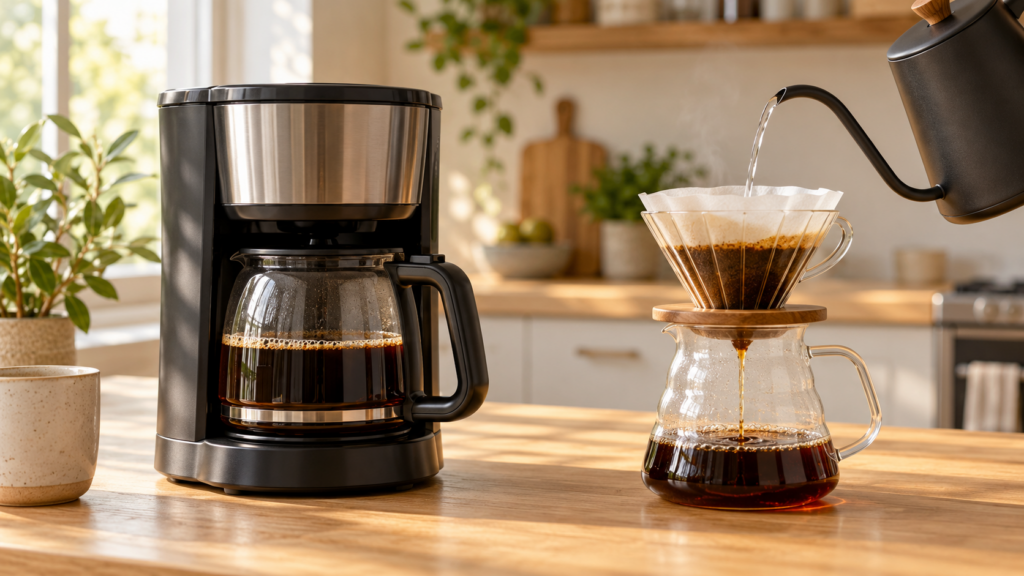
In this comparison of drip coffee vs pour over, “drip” means an automatic drip machine and “pour over” means a manual brewer with a paper filter. Both pass hot water through a bed of ground coffee and a filter, so the real differences are who controls the pour, how much attention it takes and how much coffee you need at once. If you already own a drip machine, the question is whether manual brewing adds enough to your mornings to justify the extra effort.
The 30-Second Verdict
Choose automatic drip if you want low-attention weekday brewing or a pot to share. You set it up, press a button and do something else while it brews.
Choose manual pour over if you want hands-on control over each cup and enjoy brewing as a small ritual. It asks for more attention, and in return you decide how the water meets the coffee.
If you already like the coffee from your drip machine, keeping it is a perfectly good answer. Pour over is an option to explore, not an upgrade everyone needs.
If you’d rather compare drippers, kettles and complete setups before buying, see our guide to the best pour over coffee kit.
Table of Contents
Drip Coffee vs Pour Over: Side-by-Side Comparison
| Factor | Automatic drip | Manual pour over |
|---|---|---|
| Taste | Can be very good with fresh beans, the right grind and dose, and a machine that heats and spreads water well | Can be very good; your technique affects the result, for better or worse |
| Control | The machine handles water delivery; settings vary by model | You control pour rate, pattern and timing |
| Speed and active attention | Mostly hands-off once started | You stay at the counter while you pour |
| Batch size | Commonly suits larger, shared batches; single-cup machines exist | Usually suits one or two cups; larger manual brewers exist |
| Cost | Little extra equipment if you own a machine; paper filters to restock unless it uses a reusable basket | A dripper and filters can start it with a kettle you own; scale and gooseneck are optional upgrades |
| Daily effort and cleanup | Filter changes, regular cleaning and descaling | Easy grounds disposal; dripper and mug/server still need washing |
Taste: Can a Drip Machine Taste as Good?
Yes, it can. Automatic drip and manual pour over are both filter methods: water flows through the grounds and out through a filter, rather than steeping and being pressed. With paper filters in both, the basic style of cup is similar, so the contrast you may know from French press versus pour over does not carry over here.
What shapes the cup most is shared by both methods. Fresh beans, the right dose, a suitable grind size and good water matter whichever brewer you use. Filter choice matters too, since a machine with a permanent mesh basket will not behave exactly like one with a paper filter.
The brewer and technique then make a difference. Some machines heat and distribute water well, and the Specialty Coffee Association runs a certified home brewer program that has automatic brewers evaluated by a third party against brewing-quality requirements. That doesn’t mean every machine performs that way, or that a certified machine beats every hand-poured cup.
With pour over, your technique is part of the result. HARIO notes that on its V60, changing the pour rate changes how the coffee extracts, which gives you a way to adjust the cup but also a way to get it wrong. That applies to that brewer’s design, though the general point holds: a manual method responds to what you do.
Our recommendation: if your drip coffee tastes flat, check the beans, grind and dose before buying anything. If you want to fine-tune individual cups and enjoy the process, pour over gives you more to adjust.
Control and Consistency
Hand pouring gives you direct control over how fast the water goes in, where it lands and when you stop. The pour-over guide from About Coffee describes this as manual control that improves with technique, and suggests measuring your coffee and water so you can repeat a cup you liked.
That control comes with a learning curve. Early cups can vary while you get used to pouring steadily, and a recipe only helps if you follow it closely. If you want to try it, our guide on how to make pour over coffee walks through a full starting recipe.
Drip machines handle much of this for you. A basic machine heats the water and spreads it over the grounds the same way each time, so the main choices left to you are beans, grind and dose.
Machine controls vary, and some models let you adjust settings such as temperature or brew profile. Automation makes the routine easy to repeat, but it does not guarantee good extraction if the machine, grind or dose isn’t right.
Speed and Batch Size
It helps to separate total time from active time. Both methods involve heating water and, if you grind your own beans, grinding before you brew.
With a drip machine, most of that time is hands-off. Once you’ve added water, filter and coffee, you can leave it while it runs.
With pour over, you stay at the counter for the brew itself. About Coffee gives a general range of about two to four minutes for the water to be in contact with the coffee, but heating, grinding and setup come on top of that, and you are pouring for much of it.
Batch size usually follows the same pattern. About Coffee’s drip coffee page notes that drip machines commonly make larger batches, which suits a shared pot. Pour over generally suits a focused cup or two.
There are exceptions on both sides, including single-cup drip machines and larger manual brewers, so check the capacity of the specific brewer you’re considering.
Cost and Daily Effort
The cost question is really about what you already own. If you have a drip machine, you already have a working setup, and its ongoing costs are mainly filters (unless it uses a permanent basket), coffee and cleaning.
To start manual brewing, you need a dripper, filters that fit it, a kettle you already own and a mug. About Coffee notes that a standard kettle works. A scale helps you repeat good cups, and a gooseneck kettle with a long, narrow spout makes the pour easier to control, but both are upgrades rather than entry requirements.
A grinder helps with both methods, so it isn’t a reason to choose one over the other.
Daily effort differs more than cost. A drip machine needs filter changes, regular cleaning and descaling as its manufacturer recommends. Discard the filter and grounds, then wash the dripper and mug or server as the manufacturer recommends; manual pouring also takes attention on each brew.
Choose Drip If… / Pour Over If…
Choose drip if your mornings are busy or shared. If several people want coffee at once, or you need to get ready while it brews, a drip machine fits the routine better.
Choose drip if you already like your machine. If the coffee tastes good to you and the routine works, there’s no reason to change. Better beans or a fresher grind may do more than a new brewer.
Choose pour over if you drink one or two cups and enjoy the process. If you like adjusting a recipe and paying attention to each brew, manual brewing rewards that interest.
Choose pour over if you want to try it cheaply first. A basic dripper and filters let you test manual brewing with the kettle you have, while keeping the drip machine for busier days.
FAQ
Is pour over stronger?
Not by definition. How strong coffee tastes depends mostly on the coffee-to-water ratio, grind and brewing, and either method can be made stronger or weaker. Strength of flavor, concentration and caffeine are different things, and neither method guarantees more caffeine.
Can a drip machine taste as good?
Yes. With good beans, the right grind and dose, and a machine that heats and distributes water well, drip coffee can taste excellent. Pour over gives you more ways to adjust the cup, but it doesn’t automatically taste better.
What do I need to start?
A dripper, filters that fit it, a kettle and a mug are enough to start. A scale and a gooseneck kettle are useful upgrades once you know you enjoy it.
Conclusion
Drip is the easier choice for hands-off and shared brewing, while pour over suits people who want control and enjoy the ritual. Neither one is the better method for everyone. To compare other brewing methods, visit our comparisons section, or see our home brewing guide for the bigger picture.
