
Welcome to Tea or Coffee. Explore our practical guides designed for better focus and steady energy throughout your day.
How to Use a Coffee Percolator (Plus Grind Size and Cleaning)
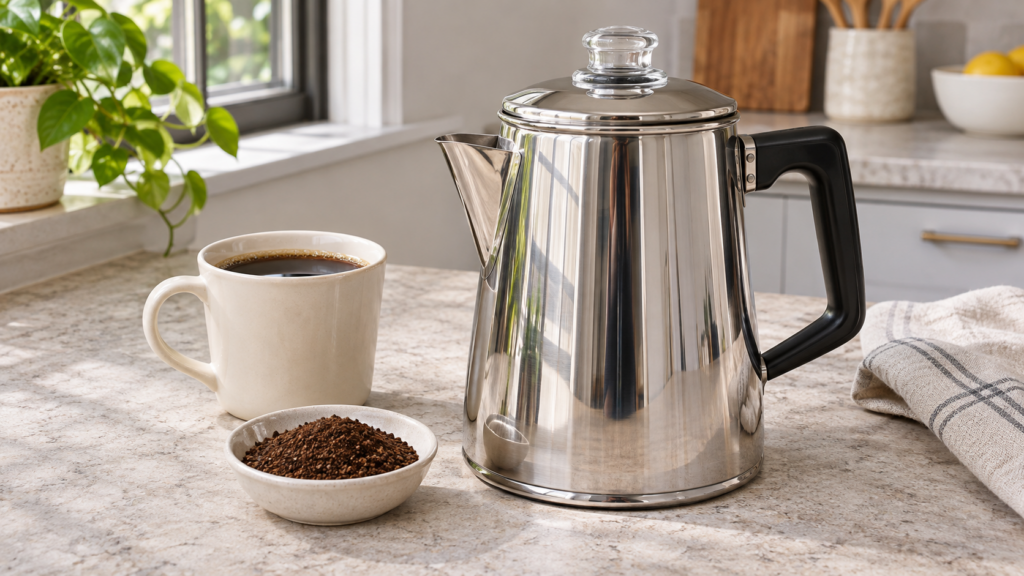
Learning how to use a coffee percolator is mostly about three things: a grind that stays in the basket, the right amount of coffee for your pot, and letting the brew cycle finish without overdoing it. Electric and stovetop percolators work on the same principle, but they’re used differently, and every model’s manual has its own measurements. This guide covers both types, then cleaning and the most common problems.
The Short Answer
Fill the pot with cold water to the marking for the number of cups you want, fit the stem and basket, and add coarse or percolator-grind coffee using your model’s chart. Then either switch on an electric percolator and let its automatic cycle run, or heat a stovetop percolator over moderate heat and take it off once it has perked for the time its maker suggests. Remove the basket before serving if your manual says to, and clean the parts once the pot has cooled.
Percolator “cups” are smaller than most mugs, and the size depends on the model. Presto, for example, counts one cup as about 5 oz of brewed coffee for its 12-cup electric models, so a full pot holds around 60 oz. Check your own manual before you plan how many mugs a batch will fill.
If you’re still choosing a machine, our guide to the best electric percolator compares models by batch size, keep-warm features and cleanup.
The Right Grind for a Percolator
A percolator basket has holes or slots, and the coffee sits in it while hot water cycles through again and again. Fine particles can pass through the basket and end up in your cup.
Most manuals point the same way, with small differences.
The Cuisinart PRC-12C series manual recommends a grind made for percolators or a coarse grind, noting that finer grinds can sift through the basket holes. The Elite EC008 stovetop manual also recommends coarse coffee and says you need a coffee filter disc if you use finer grounds. Presto’s 02815 instructions allow either regular or percolator grind.
In practice, start with a coarse grind or a pre-ground coffee labelled for percolators, unless your manual says otherwise. If you grind your own beans, our coffee grind size guide shows what coarse looks like compared with drip and espresso grinds.
How to Use a Coffee Percolator: Electric and Stovetop
Both types use a pot, a hollow stem and a perforated basket with a spreader or lid. The difference is who controls the heat: an electric percolator runs its own cycle, while on a stovetop you’re in charge.
Electric Percolator
- Add water. Remove the stem and basket, then fill with cold water to the marking for the cups you want. Stay within your model’s range: the Presto 02815, for example, says to make at least 4 cups for the best flavor and no more than 12.
- Fit the stem and basket. Put the basket on the stem, set the stem in the pot as your manual shows, and make sure it seats properly in the well at the bottom.
- Measure the coffee. Use your model’s chart and a real measuring tablespoon. The amounts differ: Presto’s 02815 chart gives 10 to 16 tablespoons for 12 cups, while Cuisinart’s PRC-12C chart gives 12 to 20 for the same cup count. Start in the middle and adjust next time.
- Close and switch on. Fit the basket lid and pot cover, then plug in or switch on. Don’t open the cover during brewing; Cuisinart warns that hot coffee can spill out.
- Let the cycle finish. The percolator decides when brewing is done. On the Presto 02815, a signal light comes on when the coffee is ready, and the Cuisinart PRC-12C switches to Keep Warm with its indicator light on. Keep-warm holds the finished coffee; it isn’t extra brewing time.
- Serve. Follow your manual on serving. For the Cuisinart, wait until perking has stopped, unplug, and use an oven mitt to remove the hot basket and pump tube. Snap the cover back on before pouring; plug back in to keep the coffee hot. The Presto 02815’s pot lifts off a powered base and goes back on to stay warm.
There’s no need to set a timer on an electric percolator or restart the cycle for “stronger” coffee. If you want a stronger cup, adjust the coffee amount within your model’s chart instead.
Stovetop Percolator
The steps below follow the Elite EC008 stovetop manual as one example. Other stovetop percolators, especially glass ones, may need a different heat level or a trivet on certain stoves, so check your own instructions.
- Add water. Fill with cold water to the marking for your number of cups. The EC008 manual says to keep the water below the spout and the pot at least half full.
- Add the basket and coffee. Fit the stem and basket, then add coarse coffee. Its chart gives 4, 6 or 8 tablespoons for 8 cups, from mild to strong.
- Heat it. Place it on medium to medium-high heat. When the water boils, turn the burner down to low or medium.
- Let it perk. The manual suggests about 5 to 7 minutes for the boiling water to percolate through the grounds. If your pot has a clear knob, you’ll see the coffee darken as it cycles.
- Remove from the heat. Use an oven mitt or potholder to take the pot off the burner. Follow your manual before serving; for the Elite EC008, use an oven mitt or potholder when removing the hot basket, stem and spreader.
A few safety points from the same manual: never let the percolator boil dry, don’t remove the lid while it’s brewing, never use it in a microwave, and don’t fill above the maximum level. Use an oven mitt or potholder: the handles and other parts can become hot.
How to Clean a Coffee Percolator
Unplug an electric percolator and let any percolator cool before you take it apart. After that, cleaning depends heavily on the model, so treat the examples below as examples, not rules.
Everyday Cleaning
Empty the grounds, then wash the basket, stem, basket lid and pot interior with warm, soapy water, rinse and dry. Pay attention to the bottom of the stem and the well it sits in. Presto’s 02811 instructions note that sediment building up in the perk well can affect perking, and Cuisinart suggests loosening grounds trapped in the pump tube washer with a toothpick.
Never immerse an electric percolator’s body, base, cord or plug. The heating element is built into the base, so wipe the outside with a damp cloth instead. The Presto and Cuisinart manuals both say this clearly.
Dishwasher permission varies by part and by model:
- The Presto 02815 allows the perk tube, basket and basket lid in the dishwasher, but not the pot or base.
- Cuisinart’s PRC-12C allows the cover, basket, lid and pump tube in the upper rack, but not the body or cord.
- The Elite EC008 stovetop pot allows all parts except the cover knob in the dishwasher.
If your manual doesn’t mention a dishwasher, hand wash. Avoid abrasive cleaners and steel wool, which several of these manuals warn against.
Deep Cleaning
Over time, coffee oils, stains and minerals build up. Again, the right method depends on the model:
- Coffee oils and stains. Presto’s 02815 manual provides a detergent-cleaning cycle for oils, stains and sediment. Follow its full Care and Cleaning procedure, including the specified water level, standing time, fresh-water cycle and final rinsing; do not substitute hand dishwashing liquid. The Elite EC008 manual gives a similar detergent method for its stovetop pot, with its own amount.
- Mineral deposits. Cuisinart’s PRC-12C manual allows 2 cups of vinegar topped up with water to the 12-cup level, run through a full cycle, followed by one cycle of plain water. The Elite EC008 says to simmer equal parts water and white vinegar for ten minutes, then rinse.
These amounts belong to those models. Use vinegar or detergent only if your percolator’s manual allows it, and in the amounts it gives. Our guide on how to clean a coffee maker with vinegar explains why the answer varies between machines, but it isn’t a substitute for your percolator’s own instructions.
Whichever method your manual allows, use one product at a time and never mix cleaning products.
Troubleshooting: Bitter, Weak or Gritty Coffee
Bitter or Burnt-Tasting Coffee
On a stovetop percolator, bitterness often comes from heat and time. Turn the heat down once it boils and stay within the perking time your manual suggests, such as the 5 to 7 minutes in the Elite EC008 manual. On an electric model, the cycle is automatic, so look at the coffee amount and grind instead, and don’t re-run a finished pot.
Old coffee oils can also affect the taste. If the pot hasn’t had a deep clean in a while, use your model’s cleaning method. Keep-warm also has limits: coffee held for a long time can taste flatter than a fresh pot, so brew what you’ll drink.
Weak Coffee
Check the measuring first. Presto’s 02811 instructions suggest making sure you use an actual measuring tablespoon, not a serving spoon. Then move up within your model’s chart, and make sure you’re brewing within its minimum and maximum, since the Presto 02815 recommends at least 4 cups for the best flavor.
On a stovetop pot, very low heat or too short a perk can also give a pale result. Make sure the pot reaches a boil before you turn the heat down.
Grounds or Sediment in the Cup
Grit usually means the grind is too fine for the basket. Switch to a coarse or percolator grind, or use a filter disc if your manual allows one, as the Elite EC008 manual suggests for finer grounds. Check that the basket lid or spreader is fitted and that the stem sits properly in its well.
A clogged stem, a dirty perk well or a worn basket can also cause problems. Clean those parts as your manual describes, and replace damaged parts only with ones your manufacturer lists for your model.
FAQ
Can I use regular ground coffee in a percolator?
Sometimes. Presto’s 02815 instructions allow regular grind, while Cuisinart and Elite recommend coarse or percolator grind because finer coffee can pass through the basket. If regular grind leaves grit in your cup, switch to coarse.
How long should a percolator perk?
For an electric percolator, as long as its automatic cycle takes; it stops on its own and switches to keep-warm. For a stovetop pot, follow your manual: the Elite EC008 suggests about 5 to 7 minutes after it starts to boil, on reduced heat.
Can I use an electric percolator outdoors?
The Presto 02815 and Cuisinart PRC-12C manuals prohibit outdoor use; an electrical hookup does not change that. The Elite EC008 stovetop example is also labelled for indoor use. For outdoor brewing, choose a percolator explicitly approved by its manufacturer for that setting and heat source.
For more brewing methods and guides, explore our home brewing guide.
