
Welcome to Tea or Coffee. Explore our practical guides designed for better focus and steady energy throughout your day.
How to Clean a Coffee Maker with Vinegar
Before you clean a coffee maker with vinegar, look up your exact model. Some makers give you precise amounts, while others tell you to keep vinegar out of the machine altogether.
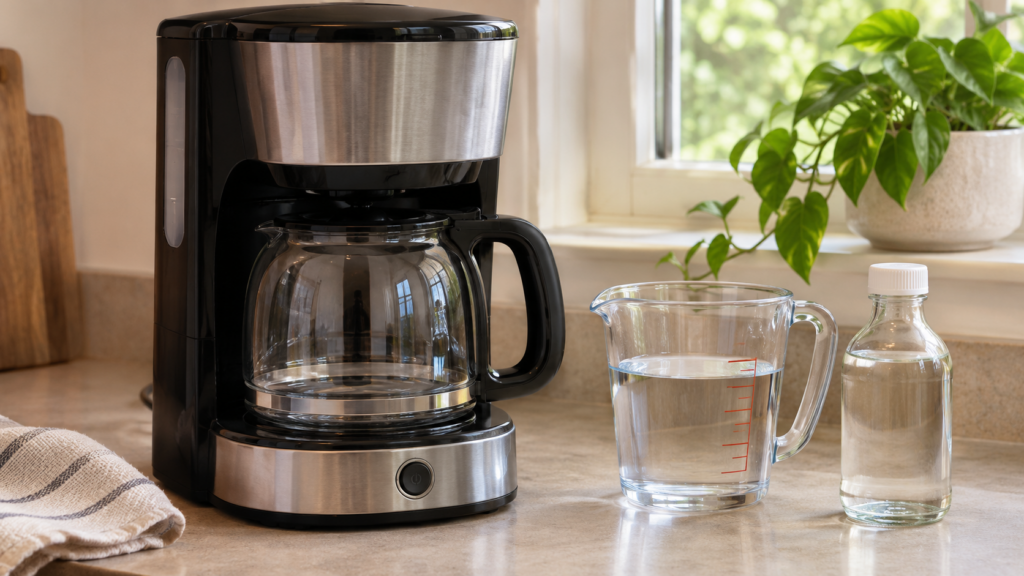
Quick answer: Check your model’s manual first, and if it rules out vinegar or names another product, follow that. One example, not a universal recipe: the Ninja CM360/CM371 guide says to add white vinegar to the 16 oz Travel Mug line, fill with water to the Full line, run one CLEAN cycle, wash the reservoir and flush with one water-only Full Carafe brew. Other machines use different amounts, pauses and rinses.
Why Scale Affects Your Coffee
Water leaves minerals behind, and over time they build up on the heating element as limescale. Moccamaster says that buildup can slow the water flow and affect brewing temperature and saturation time. The Ninja CM360/CM371 guide adds that hard water speeds it up, and that scale could affect the flavor of your coffee.
Coffee oils are a separate problem. Urnex describes them as a residue that builds up from brewing, and it treats removing them as cleaning, while descaling deals with minerals. So a vinegar cycle does not replace washing the parts you can reach.
A slow brew does not prove you have scale, either. The Ninja CM360/CM371 guide says its brew time ranges from 4 to 20 minutes depending on your settings, so check those before you blame the boiler.
Before You Start
- Confirm the product. Find your model number and manual, then check which cleaner it approves. Bosch says never to use vinegar in its coffee machines because it could cause irreparable damage, while the Ninja CM360/CM371 guide allows white vinegar but no other kind.
- Check the vinegar strength. Use a specific concentration only if your manual gives one. Many just say white vinegar, so do not swap in a stronger cleaning vinegar on your own.
- Deal with filters and accessories as directed. Do only what your manual says here. The Cuisinart DCC-1100 booklet, for example, says to remove the charcoal water filter before decalcifying.
- Cool it and unplug it before you handle or wash parts. Plug it back in only for the powered cycle your manual calls for.
- Learn which parts come off. Keep to those, do not open the housing or immerse the machine, and use a dishwasher only for parts your manual names. If you are shopping with access in mind, our plastic-free coffee maker guide shows which parts are made from what.
- Use one product at a time. Never mix vinegar, bleach, descalers or other cleaning products. The New Jersey Department of Health warns that bleach mixed with an acid produces chlorine gas, and the CDC says never to mix bleach with any other cleaners.
Routine descaling is also a different task from dealing with contamination. If you can see suspected mold, or the problem is somewhere you cannot reach, hold off on the vinegar and read our guide to mold in coffee maker parts, then ask the manufacturer for advice.
How to Clean a Coffee Maker with Vinegar
These steps are the general order of work. The amounts, timing and rinses have to come from your own manual.
- Empty the machine. With the machine cool and unplugged, discard any grounds and filter, and empty the carafe and reservoir.
- Wash the removable parts. Follow your manual’s method for each part.
- Fill the reservoir. Use only the mixture your manual approves, and stay at or below its fill line.
- Run the approved cycle. Use the setting your manual names and let it finish. Do not improvise pauses or extra cycles.
- Rinse as directed. Run the number of water-only cycles your manual gives, and do any extra washing it asks for.
- Finish the parts. Discard the rinse water, then clean the carafe and any other parts the manual lists before you brew.
Model Example: Ninja CM360 and CM371
This sequence comes from the Ninja CM360/CM371 owner’s guide and applies to those models only.
- Select the Full Carafe size and set the empty carafe under the brew basket.
- Fill the reservoir with white vinegar to the Travel Mug line (16 oz), then add water up to, but not past, the Full line (50 oz or 60 oz, depending on the model).
- Press CLEAN. The cycle takes about 60 to 75 minutes, and the machine adds its own pauses, so there is no separate soak for you to time. Do not remove the carafe during the cycle.
- When the clock shows End, empty the carafe and put it back. Wash the reservoir with warm, soapy water.
- Fill the reservoir with fresh water to the Full line and run one Full Carafe, Classic brew with water only.
- Discard the water and clean the carafe thoroughly.
The guide does not give a vinegar concentration, or say whether a filter stays in the holder during the cycle. It does say that a cancelled cycle leaves the machine not properly descaled, though you still need to finish the washing and flush, and that a water-only clean cycle will not descale it properly.
Other machines differ a lot. The Hamilton Beach FlexBrew 49921 manual calls for 1 1/2 cups (355 mL) of plain white vinegar, a 30-minute pause partway through and 2 to 3 water-only cycles. The Cuisinart DCC-1100 booklet uses a mix of 1/3 white vinegar and 2/3 water, then one cycle of fresh cold water, so never combine steps from different manuals.
Machine-Specific Cleaning Guides
For capsule machines, see how to clean a Nespresso machine, with daily care, a worked Essenza Mini descaling example and guidance for Vertuo owners. Nespresso does not recommend vinegar.
For the complete CLEAN cycle and removable-parts care, see how to clean a Ninja coffee maker, with steps for the CM360 and CM371.
For Cuisinart drip brewers, see how to clean a Cuisinart coffee maker, with DCC-3200 self-clean steps and the differences for DCC-3000C and DCC-1200C models.
For pod brewers, see how to clean a Keurig, including a model-specific descaling example and pod-holder and needle care.
This guide stays generic on purpose. Pod brewers, capsule machines and espresso machines can have their own descaling modes, products and button sequences, so go to the manual for your model or the maker’s support pages, such as Keurig’s cleaning tips.
For espresso machines, see our guide to descaling an espresso machine, with a model-specific Breville example.
Vinegar Alternatives
If your manual names a descaler, use that first, as the Ninja CM360/CM371 guide does with a coffee maker descaling solution used by its package directions. Moccamaster goes further and does not recommend vinegar, saying it is not strong enough to break down mineral buildup and can leave a lingering odor and aftertaste. Citric acid is another option people ask about, but use it only if your manual allows it, since no single recipe suits every machine.
FAQ
Does vinegar disinfect a coffee maker?
Do not treat it that way. A vinegar cycle is a descaling step, not proven disinfection or mold removal.
How often should I descale?
There is no universal schedule. The Ninja CM360/CM371 lights its CLEAN button when a cycle is recommended, the Hamilton Beach FlexBrew 49921 manual says at least once a month and weekly with hard water, and Keurig’s tips say every three months.
Why is the clean light still on after a cycle?
That depends on the machine. Ninja’s guide says the CM360/CM371 may need a second cycle to remove more mineral buildup, and Cuisinart’s DCC-1100 booklet says to repeat with a fresh solution if the light still flashes.
How do I get rid of the vinegar smell?
Finish every rinse your manual asks for, and wash the reservoir and carafe if it says to. If you can still smell vinegar, run another water-only brew unless your manual says otherwise.
Once the machine is clean, our home brewing guide covers the rest of your setup.
