
Welcome to Tea or Coffee. Explore our practical guides designed for better focus and steady energy throughout your day.
Best Plastic-Free Coffee Makers: Glass & Stainless Picks That Brew Well
Glass, ceramic and stainless coffee makers compared by what actually touches your water, including what plastic and silicone remain.
Disclosure: Tea or Coffee may earn a commission if you buy through links on this page, at no extra cost to you. Our picks are based on our own research and are not paid for by brands. Read our full disclosure.
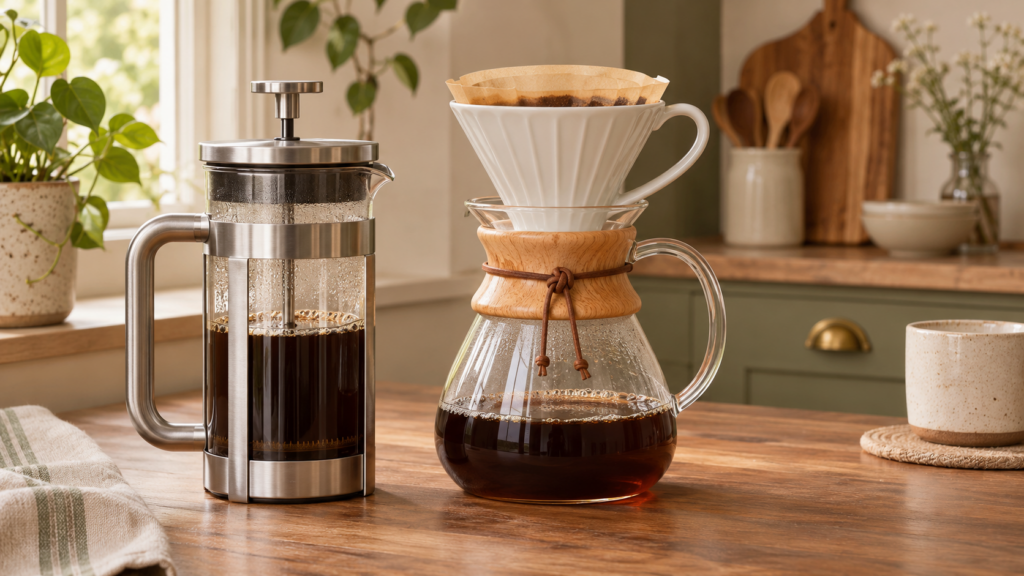
Choosing a plastic-free coffee maker starts with deciding how far you want to go. If you want no plastic at all, buy a manual brewer such as the Frieling French press, which its maker says has no plastic anywhere, or a glass Chemex; if you want a machine, the Ratio Eight Series 2 keeps plastic away from hot water by its maker’s account, although its cold-water tank and base are still plastic. We compared these from manufacturer documents and published reviews rather than our own testing, and we list what remains in each one, including silicone.
Table of Contents
Top Picks at a Glance
Best fully plastic-free
Frieling Iconic French Press
Its maker describes it as stainless steel with no plastic anywhere.
Best stainless drip machine
Ratio Eight Series 2
Glass water lines and a stainless basket; the cold-water tank is plastic.
Best budget
Hario V60 Ceramic Dripper 02
A porcelain cone, paper filters and the mug you already own.
| Model | Water-path materials | Type | Capacity | Price tier | Link |
|---|---|---|---|---|---|
| Frieling Iconic French Press (polished or brushed) | 18/10 stainless steel per the maker, which also states no plastic anywhere. Silicone not mentioned; no part-by-part list found | Manual French press | 17, 23, 36 or 44 fl oz | $$ | Frieling |
| Ratio Eight Series 2 (glass carafe) | Hot path: glass water lines, 304 stainless shower head and basket, uncoated aluminum heater, silicone gaskets and tubing, glass carafe and lid. Remaining plastic: Tritan cold-water tank, polymer base | Automatic drip | Up to 40 oz | $$$ | Ratio |
| Chemex Classic 6-Cup (CM-6A) | Borosilicate glass and paper filter. Rubber wood collar and bead and leather tie sit outside the brew | Manual pour-over | 30 oz | $ | Chemex |
| Hario V60 Ceramic Dripper 02 (white or red) | Porcelain dripper and paper filter. Your own mug or server sits below it | Manual pour-over cone | 1 to 4 cups | $ | Hario |
What “Plastic-Free” Really Means
The label gets used for three different things, and they are worth keeping apart. Fully plastic-free construction means no plastic anywhere in the product, which in this guide applies to manual brewers, based on what their makers state. A verified plastic-free water path is narrower: the parts that touch water contain no plastic, whatever the housing is made of.
Lower-plastic covers everything else, such as a machine with steel and glass in some places and a plastic basket in others.
Where a part sits matters. A plastic handle or base never touches your coffee, while a tank, basket or lid may, so a non-plastic exterior tells you little about the inside. “Stainless” on a box often describes the housing and not the water path.
Electric machines are the hard case, because water travels through a tank, tubing, connectors and a heater that you never see. We only describe an electric path when the maker documents those parts, and the one here that meets that test still has a plastic cold-water tank, so no electric pick on this page counts as a coffee maker without plastic parts.
We list silicone tubing and gaskets by name rather than folding them into metal or glass. The table shows where they appear, and where we could not find an answer we say so.
Best Fully Plastic-Free: Frieling Iconic French Press
This is the most direct answer to “no plastic coffee maker,” because Frieling lists its Iconic presses as 18/10 double-wall stainless steel with “no plastic anywhere.” Frieling describes the pot, lid and plunger as steel, and the filter is a set of screens, a plate and a cross, so there is no paper filter to buy either.
That statement is the maker’s, and it comes without a part-by-part list. Neither the product page nor the user manual mentions silicone or rubber seals, and we have not independently verified every part. Check the exact version too, since the Coffee in Color models have a lacquered exterior.
Steel is easy to live with: Frieling says all parts are dishwasher safe, and the manual rules out stovetops and microwaves. It is also the priciest manual pick here, and the listing has shown a back-in-stock option, so check availability for your size. A larger 36 or 44 oz press suits households, while the 17 oz size suits one person.
If you would rather brew by pouring, all-ceramic and all-glass cones are the other route to zero plastic. Compare the wider field in our guides to stainless steel French press picks and glass and ceramic pour-over setups, but check each model’s materials there, because not everything in those guides is plastic-free.
Best Stainless Drip Machine: Ratio Eight Series 2
If you want to press a button, this is the best-documented option we found, and it is a lower-plastic machine with a plastic-free hot path rather than a plastic-free machine. Ratio’s comparison page names each part: borosilicate glass water lines, a 304 stainless steel shower head, a double-wall stainless basket, a glass carafe and glass lid. That published detail is why it won this slot.
The cold-water tank is Eastman Tritan, a plastic that Ratio says has no hot water contact, and the base is a matte polymer over a metal structure. The heating element is uncoated aluminum, and the silicone gaskets and tubing do touch hot water. The optional thermal carafe also has a silicone lid.
The brewing side has some independent support. Forbes Vetted’s reviewer tested one at home for a week and found batches consistently fragrant and flavorful. She also found that a full batch took over ten minutes, that you cannot pour mid-brew or schedule a brew, and that the steel basket gets very hot.
The obvious catch is price, since this is the only pick in the top tier. Ratio’s cheaper machines are a step down on materials: the Ratio Four lists Tritan among its hot-water parts and ships with a polypropylene basket, so treat it as a lower-plastic option, even if you swap in a metal dripper.
Best Glass Brewer: Chemex Classic 6-Cup
The Chemex keeps things simple: one piece of borosilicate glass with a rubber wood collar, a wooden bead and a leather tie. Brewing happens in the glass through a paper filter, so there is no lid, seal or tube to ask about. At 30 oz, it can serve more than one person.
Its filter is the main running cost. Tom’s Guide tried unbranded filters that did not fit the shape and let grounds through, so check the fit if you buy anything but Chemex filters. The same reviewer liked the balanced, silt-free cup, though that is one person’s result with one recipe.
Glass asks for more care: the carafe gets hot, so hold it by the collar, and Chemex says to take the collar and tie off before washing, which Tom’s Guide found fiddly. Chemex allows the dishwasher if the glass is secure, and says not to reheat it in a microwave. If your household is hard on glassware, the steel Frieling is the better buy.
Non-Toxic Espresso Options
People often search for a non toxic espresso machine, but that is a search label, not a safety certification, and we do not use it as a claim. We have no espresso pick here, because we did not find one with enough documented materials detail to recommend on this basis.
Materials vary by model, so ask the maker directly about the boiler, group, tubing and seals before you buy. For brewing and features, start with our espresso machine buying guide, and treat any plastic-related claim there as something to verify for the specific model.
Best Budget: Hario V60 Ceramic Dripper 02
For the lowest price of entry, this porcelain cone from Japan is hard to argue with, and it is listed at the bottom tier. It brews 1 to 4 cups straight into a mug or server, so it takes almost no storage.
It needs a kettle and your attention while you pour, it holds no coffee of its own, and porcelain will chip if dropped. Your server matters as well, since a plastic one would undo the point. Hario’s US store showed the ceramic versions as sold out on 4 November 2026, while Hario Global listed the white and red versions in stock.
Be careful with the name, because Hario also sells a plastic V60. Pick this over the Chemex if you drink one or two cups, and pick the Chemex if you want a carafe included.
How We Chose
We started with materials transparency. A model only made this list if its maker named the materials in the parts that matter, and a clear published list counted for more than a confident slogan. Where makers left a gap, we kept the pick only if we could say so honestly, as with seals on the Frieling.
After that we looked at published brewing evidence, durability, care and value. The evidence for brewing is uneven: Ratio Eight and Chemex have hands-on reviews behind them, while the Frieling and V60 picks rest more on materials, so read those as materials recommendations. We did not score the picks numerically, and there are no durability results here, only the warranty and care information each maker publishes.
Everything is checked against US listings. Models and materials can change, so confirm the details on the exact version you buy.
FAQ
Are any electric coffee makers completely plastic-free?
We did not find one among the machines we researched, and we cannot rule out every model on the market. The Ratio Eight Series 2 comes closest by documentation, keeping plastic out of hot-water contact by its maker’s account, but it still has a plastic tank and base.
Is BPA-free the same as plastic-free?
No. BPA-free describes one chemical that a plastic was made without, and the material is still plastic. Ratio’s Tritan tank is a good example: it is labeled BPA-free, and it is a plastic.
Does plastic-free brewing taste different?
We found no evidence that lets us say so. The differences you notice between these brewers are more likely to come from the method, filter, grind and recipe, so choose this category for the materials and not for a flavor promise.
Whatever materials you choose, look for parts you can reach, wash and dry. If you find suspicious residue, our guide to mold in coffee maker parts explains what to inspect and when to contact the manufacturer. For mineral buildup, check whether your manufacturer allows you to clean a coffee maker with vinegar before choosing a descaling method.
For the strictest option, start with the Frieling, which its maker says has no plastic anywhere, or the Chemex, and for a machine, the Ratio Eight is the best-documented compromise we found. For the rest of your setup, see our home brewing guide.
