
Welcome to Tea or Coffee. Explore our practical guides designed for better focus and steady energy throughout your day.
Matcha for Beginners: What It Is, How to Make It, What to Buy
Matcha is green tea ground into a fine powder that you whisk into water, so you drink the whole leaf instead of an infusion. This matcha guide for beginners covers what matcha is, what grade labels tell you, how to prepare it and where to start when buying. Each section points to a more detailed article if you want to go further.
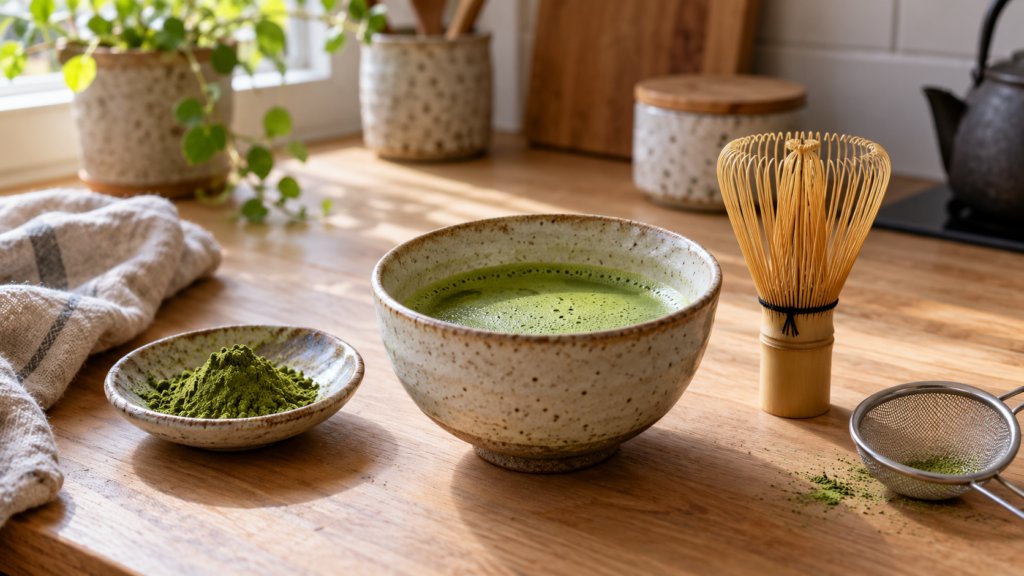
Table of Contents
What Is Matcha
Matcha comes from the same tea plant as other green teas, Camellia sinensis. It starts as tencha, a green tea grown in the shade before harvest.
Kyoto Obubu Tea Farms describes about four weeks of shading, then steaming, drying and removing the stems and veins. The dried leaf is then ground into powder, traditionally in a stone mill.
Because you whisk the powder into water and drink it, you consume the leaf itself. That’s the main difference from brewed green tea, where you steep the leaves and throw them away.
There are two traditional ways to drink it. Usucha (thin tea) is the everyday style and the one this guide teaches. Koicha (thick tea) uses twice the powder and half the water: Ippodo’s guide gives 4 g of matcha to 30 ml of water, mixed slowly back and forth.
Caffeine. A 2021 review in Molecules reports 18.9 to 44.4 mg of caffeine per gram of matcha, depending on the sample (Kochman et al.). A typical 2 g serving would therefore contain roughly 38 to 89 mg. For comparison, Mayo Clinic lists about 96 mg for an 8 oz (237 ml) cup of brewed coffee and about 29 mg for brewed green tea.
L-theanine. Matcha also contains L-theanine, an amino acid found naturally in tea leaves. The same review notes that tencha, the leaf used for matcha, is reported to contain more theanine than other teas.
Matcha Grades Explained
You’ll see two labels on most matcha: ceremonial and culinary. In practice, sellers use “ceremonial” for powder meant to drink with water alone, and “culinary” for powder meant for lattes, smoothies and baking, usually at a lower price.
These labels aren’t an official standard. Ippodo, a long-established Kyoto tea company, says it doesn’t use the term “ceremonial grade” because it isn’t used in Japan. Two powders with the same label can differ a lot in quality.
So treat the grade as a hint about intended use, not a guarantee. When you compare powders, check these:
- Origin: the region or producer, not just “Japanese matcha”
- Intended use: drinking straight, lattes or baking
- Freshness information: a production date or best-before date
- Packaging: sealed, airtight and protected from light
- Price per gram: easier to compare than tin price, since tin sizes vary
Package size also tells you how long a tin will last. At 2 g per bowl of usucha, a 20 g tin makes about 10 servings, a 40 g pack about 20 and a 100 g bag about 50. A latte made Ippodo’s way uses 3 g, so the same 100 g bag makes about 33 lattes.
If you mainly plan to make lattes, a powder sold for lattes or culinary use is a sensible first buy. Save the most expensive powders for drinking with water, where you’ll actually taste the difference.
How to Prepare Matcha
Traditional (Whisk)
This is the usucha (thin tea) method from Ippodo’s preparation guide:
- Heat water to 80°C (176°F). Ippodo suggests cooling just-boiled water by pouring it into a cup first.
- Add 2 g of matcha to a bowl. That’s about one level teaspoon, or about one and a half heaping scoops with a bamboo tea scoop (chashaku). Sifting it first helps break up clumps.
- Pour in 60 ml of the water.
- Whisk vigorously for about 15 seconds with a bamboo whisk (chasen), moving it in an “M” shape rather than in circles.
Drink it as is, or turn it into a latte. Ippodo’s iced matcha latte recipe whisks 3 g of matcha into 100 ml of 80°C water, then pours it over 100 ml of cold milk and ice. For a hot latte, Ippodo uses the same amounts with warm or foamed milk.
Either way, that’s equal parts matcha mixture and milk, with 3 g of powder instead of the 2 g used for a plain bowl.
Whisk the matcha into water first and add the milk afterward. Powder added straight to milk tends to clump.
Quick fixes for common problems:
- Clumps: sift the powder before adding water.
- Little or no foam: whisk faster, moving the whisk in an “M” shape instead of stirring in circles.
- Latte tastes weak: In its FAQ for Ikuyo matcha, Ippodo says this usually comes down to the recipe, especially when there’s more milk than water. Go back to equal parts.
No-Whisk Shortcuts
You don’t need a bamboo whisk to start:
- Shake it, with cold water only. Put the matcha and cold water in a bottle or jar with a tight lid, leaving room to shake. Shake hard until no clumps remain. Ippodo recommends cold water for matcha made in a bottle, and notes it settles, so shake again before you sip. Never shake hot or warm liquid in a sealed container: BlenderBottle warns that trapped pressure can make the lid open unexpectedly and spray the contents.
- Use a milk frother. A handheld frother mixes matcha into a little hot water quickly. It works well for latte bases.
- Use a blender. For smoothies, add the matcha with everything else and blend.
- Try instant matcha. It’s made to mix without a whisk, but products differ. Some are meant for hot water, some for cold water or milk, and some contain sugar or milk powder. Follow the instructions on your pack rather than assuming every instant matcha dissolves the same way.
What to Buy
Buying for someone else? Our matcha and tea gift guide covers kits, powders and useful tools by budget and drinking style.
If you’re buying your first matcha, start here:
Best matcha powder
Our guide to choosing a matcha powder, whether you’ll drink it straight or use it in lattes.
Best instant matcha
For mornings without a whisk: matcha made to mix quickly, with notes on hot vs cold preparation.
Beyond the powder, the basics are short:
- A whisk, frother or lidded jar to mix the powder (see the shortcuts above)
- A small fine-mesh strainer for sifting
- A bowl or wide mug with room to whisk
- A scoop or teaspoon. One level teaspoon is about 2 g, the amount for one bowl of usucha.
- A way to get water to about 80°C: a kettle with a temperature setting, or just-boiled water cooled in a cup first
Everything else, from matching bowls to whisk stands, is optional.
Matcha Recipes
Once you have a powder you like, lattes are the easiest place to start. Ippodo even notes that a slightly astringent matcha pairs well with milk.
Our matcha latte recipe covers the method step by step, including hot and iced versions.
For a fruity version, try our strawberry matcha latte with a fresh strawberry base and layered pouring steps.
Matcha and Focus
Matcha contains both caffeine and L-theanine, and some studies have looked at what the two do together. A 2021 systematic review in Cureus reported positive results for attention (Sohail et al.). But it covered only five studies, two of them with fewer than ten participants, and the doses differed. So it can’t tell you what a bowl of matcha will do for you.
How matcha feels also varies from person to person, and the caffeine in your cup depends on the powder and how much you use. For a closer look at timing and serving size, see our article on matcha tea for focus.
Matcha Routines
Matcha is easiest to enjoy when it becomes a simple habit: the same powder, the same amount and the same method each time. That also makes it easier to notice what you like and adjust.
A few things help a routine stick:
- Keep everything in one place: powder, whisk or frother, strainer and scoop.
- Measure the same way every time, with the same spoon or a small scale.
- Change one thing at a time, such as the amount of powder or water, so you know what made the difference.
- Keep track of caffeine if you also drink coffee or tea later in the day.
If you’d like a ready-made structure, our matcha morning routine walks through a realistic routine from kettle to cup.
FAQ
How much caffeine does matcha have compared to coffee?
A 2 g serving of matcha contains roughly 38 to 89 mg of caffeine, based on the range in the Molecules review. Mayo Clinic lists about 96 mg for an 8 oz cup of brewed coffee. The real amount in your cup depends on the powder and the serving size; our caffeine in tea vs coffee comparison has the full breakdown.
Why is matcha expensive?
Matcha takes more steps than ordinary green tea. The plants are shaded before harvest, and the stems and veins are removed before the leaves are ground.
Stone grinding is also slow. Kyoto producer Horii Shichimeien says one tea millstone grinds only about 40 g an hour. Not every matcha is made the same way, which is one reason prices vary so much.
How should I store it?
Keep matcha sealed and away from sunlight, heat, humidity and strong smells, as Ippodo recommends. Ippodo says room temperature is fine and recommends resealing the bag between uses.
Once it’s open, use it fairly soon. Ippodo advises finishing its opened teas within about a month for the freshest flavor and aroma.
Full Matcha Article Index
