
Welcome to Tea or Coffee. Explore our practical guides designed for better focus and steady energy throughout your day.
Best Espresso Machine for Home: Picks That Earn Their Counter Space
The best espresso machine for home depends on how much hands-on work you enjoy, whether you make milk drinks and how much counter space you can spare. We selected six semi-automatic machines, from a simple budget model to a dual-boiler machine for milk-drink fans, using manufacturer specifications and published reviews.
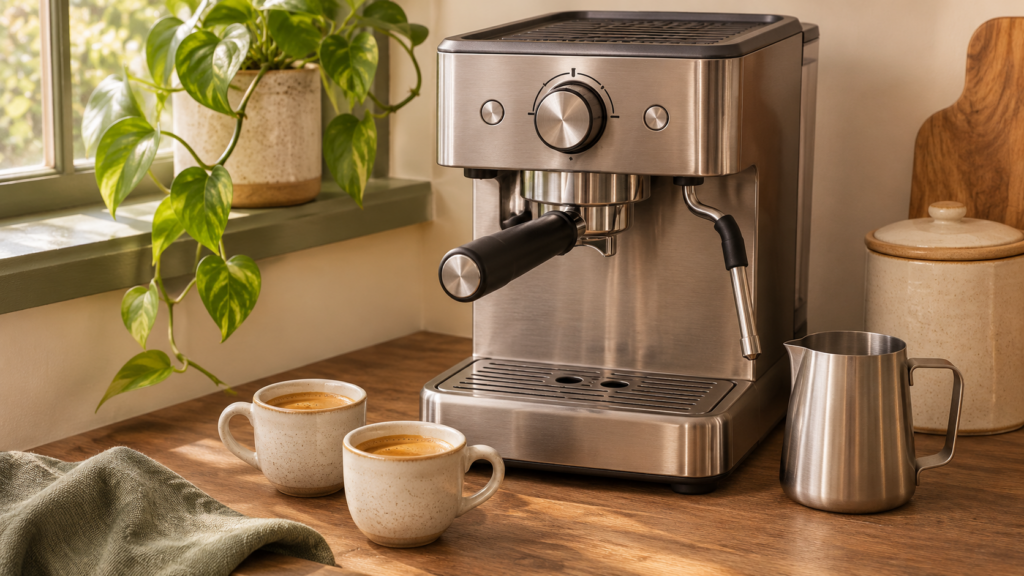
You prepare the espresso yourself on all six. For one-touch milk drinks, choose a latte machine with an integrated automatic milk system.
Table of Contents
Top Picks at a Glance
Best overall
Breville Barista Pro
an all-in-one machine with a built-in grinder and quick-heating system
Best for beginners
Breville Bambino Plus
a small machine with automatic milk texturing. You still make the espresso yourself
| Model | Type | Milk system | Footprint | Price tier | Link |
|---|---|---|---|---|---|
| Breville Barista Pro | Semi-automatic; manual preparation | Manual steam wand | Larger all-in-one; grinder included | $$$ | Breville |
| Breville Bambino Plus | Semi-automatic; manual preparation | Automatic milk texturing (not one-touch latte) | Small machine; allow space for a separate grinder | $$ | Breville |
| Rancilio Silvia Pro X | Semi-automatic; manual preparation; dual boiler | Manual steam wand; brew and steam at the same time | 250 × 420 mm body; separate grinder | $$$$ | Rancilio |
| Gaggia Classic Pro E24 | Semi-automatic; manual preparation; single boiler | Manual steam wand | 8 × 9.5 in body; separate grinder | $$ | Gaggia |
| De’Longhi Dedica Duo EC890M | Semi-automatic; manual preparation | Manual steam wand | Very narrow body; separate grinder | $ | De’Longhi |
| De’Longhi Stilosa EC260BK | Semi-automatic; manual preparation; manual shot stop | Manual milk frother | Small basic machine; separate grinder | $ | De’Longhi |
“Automatic milk texturing” means the machine steams milk for you after you’ve pulled the shot. It is not a one-touch latte machine. Price tiers compare these six machines only, from $ (lowest) to $$$$ (highest), and prices change, so check current listings before buying.
How to Choose the Best Espresso Machine for Home
Most of the difference between home espresso machines comes down to four things: how they heat water, how they handle milk, how much room they take up and how much upkeep they need. Before any of that, budget for a grinder.
All of these picks except the Barista Pro need a separate grinder if you want to grind fresh beans, and espresso asks more of a grinder than most other brewing methods. A grinder that suits filter coffee won’t necessarily grind fine and evenly enough for espresso, especially with a non-pressurized basket. Our coffee grind size guide explains why grind matters, and we’re preparing a dedicated espresso grinder guide.
Pressure and heating
Many spec sheets advertise a 15-bar pump. That figure describes the pump’s rating, not the pressure your coffee actually sees, so it isn’t a reason to rank one machine above another. Breville and Gaggia both describe around 9 bars of extraction pressure for the models here.
Heating systems vary more than pressure. Breville’s ThermoJet heats water on demand and is designed to heat up quickly.
A single boiler, as in the Gaggia, holds water at temperature but has to switch between brewing and steaming. A dual-boiler machine like the Rancilio keeps separate boilers for each, so you can brew and steam at the same time.
A quick heater only speeds up one step, though. Grinding, tamping, warming cups and steaming milk still take time, so a heater that is ready in seconds doesn’t mean the whole drink is ready in seconds.
PID stands for proportional-integral-derivative, a type of electronic controller that keeps water temperature more stable by adjusting the heating continuously. More stable temperature makes it easier to repeat a good shot. The Barista Pro, Bambino Plus and Silvia Pro X list PID control; the Gaggia Classic Pro E24’s US listing does not.
Milk system
A manual steam wand gives you full control over milk texture, but it takes practice to get smooth, glossy milk. Automatic milk texturing, as on the Bambino Plus, heats and textures milk to a setting you choose, which is easier for beginners. For the milk texture and serving differences, compare latte, mocha, flat white and macchiato.
On a single-boiler machine, you usually wait for the machine to switch from brewing to steaming. A dual boiler avoids that wait, which is useful if you make several milk drinks in a row.
If you don’t have a steam wand at all, you can still froth milk in a French press. It makes a good foam for home drinks, though not the same fine microfoam a steam wand can produce.
Counter space
Measure more than the machine’s footprint. You’ll need room to reach and refill the water tank, swing the steam wand, knock out the puck and remove the drip tray for cleaning.
If the machine doesn’t include a grinder, add space for one. A small machine plus a separate grinder can take up as much room as an all-in-one.
Maintenance
Rinse the portafilter and basket after use, empty the drip tray, and clean and purge the wand after milk texturing as your manual directs. Descaling, backflushing and water filters are model-specific, and backflushing isn’t suitable for every machine. Follow your machine’s manual rather than a general routine, and use the water and descaling products its manufacturer recommends.
Best Overall: Breville Barista Pro
Type: semi-automatic; manual preparation · Price tier: $$$
The Barista Pro combines a grinder and espresso machine in one unit. Breville lists an integrated grinder with 30 settings, a 54 mm portafilter, PID temperature control, its ThermoJet heating system and a manual steam wand. You can use programmed shot volumes or control the shot manually.
The main advantage is the workflow: grind, dose, tamp and brew without a second appliance on the counter. That makes it a sensible first serious espresso setup, as long as you’re happy to tamp and steam by hand.
Serious Eats’ Breville espresso machine guide liked the Barista Pro’s control and integration. It also reported that the built-in grinder is less precise than a good standalone espresso grinder.
The compromise: you pay for the built-in grinder even if you later add a standalone one. You can still use the Barista Pro to brew with separately ground coffee.
Choose it if: you want a complete espresso setup in one machine and are comfortable learning manual milk steaming.
Best for Beginners: Breville Bambino Plus
Type: semi-automatic; manual preparation · Price tier: $$
The Bambino Plus is small and quick to heat, with a 54 mm portafilter, PID and ThermoJet heating. Its standout feature is automatic milk texturing, with three temperature and three texture settings. You place the jug under the wand, choose the setting and let the machine steam the milk.
You still dose, tamp and pull the espresso yourself, so it isn’t a push-button latte machine. What it does is take one of the hardest beginner skills, milk steaming, off your plate while you learn to make good shots. Serious Eats recommended it in its espresso machine roundup after comparative testing.
The compromise: there’s no built-in grinder. Add a suitable espresso grinder and the total cost and counter space go up, which is why the Barista Pro edges ahead as our overall pick. If you already own a good espresso grinder, the Bambino Plus may suit you better.
Choose it if: you’re new to espresso, drink milk drinks and want help with steaming while you learn the shot.
Best with a Milk System: Rancilio Silvia Pro X
Type: semi-automatic; manual preparation · Price tier: $$$$
The Silvia Pro X is a dual-boiler machine with two PID controllers, a 58 mm portafilter, a manual steam wand and a 2-liter water tank. Rancilio lists body dimensions of 250 × 420 × 390 mm (width × depth × height). In the US, it is sold through Rancilio’s distribution partners.
Its advantage for milk drinks is the workflow. With separate brew and steam boilers, you can pull a shot and steam milk at the same time instead of waiting for one boiler to switch modes.
A review by Kaffeemacher reported good results once the machine was properly warmed up and shots were spaced sensibly, and found brewing and steaming at the same time convenient. The reviewer also described the steam pressure as moderate, the wand as hot to handle and the drip tray as awkward.
The compromise: it costs far more than the other picks, needs a separate grinder and takes time to warm up. The steaming is manual, so smooth milk still depends on your technique.
Choose it if: you make milk drinks regularly, want to brew and steam together and are willing to invest in a premium setup.
If you’d rather have a machine that makes the whole drink for you, a fully automatic latte machine is a better fit. Our latte machine guide covers those options.
Best Italian-Style Machine: Gaggia Classic Pro E24
Type: semi-automatic; manual preparation · Price tier: $$
If you want an espresso machine made in Italy, the Gaggia Classic Pro E24 is a classic single-boiler design. Gaggia’s US listing describes a lead-free brass boiler, a 58 mm portafilter, a manual steam wand and simple rocker switches. It lists a 15-bar pump with brewing regulated to 9 bars, and body dimensions of 8 × 9.5 × 14.2 inches.
Where it’s made doesn’t by itself make it better, but the straightforward controls appeal to people who like a traditional machine. Tom’s Guide found it made good espresso once the reviewer learned a temperature routine, and noted a steeper learning curve and some weak accessories.
The compromise: with one boiler, you switch between brewing and steaming, and the US listing doesn’t mention PID control. Getting consistent shots takes more attention than on the Breville picks, and you’ll need a separate grinder.
Choose it if: you want a simple, traditional machine with a manual wand and enjoy learning its quirks.
Best Compact: De’Longhi Dedica Duo EC890M
Type: semi-automatic; manual preparation · Price tier: $
The Dedica Duo has a very narrow body, which makes it easy to fit into a small kitchen. De’Longhi describes a portafilter machine for ground coffee with espresso presets, a manual steam wand and a 15-bar pump.
TechRadar’s reviewer used it for three weeks and reported consistent espresso. They also reported that it came with pressurized baskets, that the status lights were confusing and that it dripped after shots. Included accessories can vary by market, so check what comes in the box where you buy it.
It also has a cold-extraction mode. That’s a different process from traditional overnight cold brew, so it isn’t a reason to choose it over a dedicated cold brew maker.
The compromise: a narrow body doesn’t remove the need for space to refill the tank and use the wand. Pressurized baskets are forgiving but limit how far you can fine-tune shots without changing baskets, and you’ll still need a grinder for fresh beans.
Choose it if: counter space is your main constraint and you want an affordable machine with a steam wand.
Best Budget: De’Longhi Stilosa EC260BK
Type: semi-automatic; manual preparation; manual shot stop · Price tier: $
The Stilosa is the lowest-cost machine here. De’Longhi lists a 15-bar pump, a stainless-steel boiler, a manual milk frother, a manual extraction stop and a water tank of about 1 liter. It comes with a scoop and tamper.
Tom’s Guide found it capable of good espresso and steamed milk with practice. The reviewer criticized its plastic feel and the included accessories, and discussed replacing some of them.
The compromise: you stop each shot by hand, so you’ll need to watch it. Budget for a milk pitcher, a grinder and possibly better accessories, which narrows the price gap with the next tier up.
Choose it if: you want to try espresso at home for the lowest upfront cost and don’t mind learning by hand.
How We Chose
We selected these machines through research, comparing manufacturer specifications with published firsthand reviews. This is not a side-by-side test by TeaOrCoffee.
We weighed six factors:
- shot quality and consistency (given the most weight)
- ease of use for beginners, including grinding
- milk steaming
- maintenance
- heat-up time and footprint
- value for the complete setup
We counted the cost and space of a separate grinder wherever a machine needs one. The “best for” labels describe specific needs; the overall pick is the one that balances all six factors best for most home users.
Zuzka owns the Bambino Plus and a Sage Barista Express and says both suit her well. That owner comment does not establish comparative performance or cover the Barista Pro.
We have no long-term durability comparison and have omitted unclear dimensions. Follow each machine’s maintenance manual.
FAQ
How do you use an espresso machine?
The basic steps are: heat the machine, grind and dose your coffee into the portafilter, tamp it evenly, lock it in and start the shot. Steam milk afterwards if you want a milk drink, then clean the portafilter and purge the wand. Each machine differs, so start with your manual. For the general workflow, follow our how to use an espresso machine guide.
Can a Keurig make espresso?
Standard K-Cup brewers make coffee, and the K-Café’s concentrated coffee shot is different from traditional espresso. Newer models need a separate check: Keurig markets the K-Crema’s pressurized drinks as “espresso-style shots.” Our guide to whether a Keurig can make espresso explains those distinctions.
Are espresso beans different from coffee beans?
Not fundamentally. "Espresso" on a bag usually describes a roast or blend the roaster thinks suits espresso brewing, and you can brew most beans as espresso if they’re ground correctly. See our guide to espresso beans vs coffee beans for the differences.
How do you descale an espresso machine?
Follow your machine’s manual. Descaling methods, products and intervals differ between models, and how often you need to descale also depends on your water. Use the descaler your manufacturer recommends rather than a generic home remedy.
Final Verdict
For most people starting out, the Breville Barista Pro is the most complete choice because it includes the grinder. If you already own a good espresso grinder and want help with milk, the Bambino Plus is excellent. If you make milk drinks every day and have the budget, the Silvia Pro X lets you brew and steam at the same time.
Buying an espresso machine as a gift? Our coffee lover gift guide covers the recipient checks to make first, including their existing grinder, interest in hands-on brewing and preference for milk drinks.
The Gaggia suits traditionalists, the Dedica Duo suits small kitchens and the Stilosa is the cheapest way to start. Whichever you choose, budget for a suitable grinder and give yourself time to learn. For other ways to make coffee at home, see our home brewing guide.
