
Welcome to Tea or Coffee. Explore our practical guides designed for better focus and steady energy throughout your day.
How to Make Iced Coffee with a Regular Coffee Maker
Two ways to make iced coffee with your drip machine, with exact coffee, water and ice amounts so it does not taste watered down.
Quick answer: To learn how to make iced coffee with a coffee maker, start by brewing it twice as strong as usual: 40 g of coffee to 320 ml of water. Pour it over 100 g of ice and 60 ml of cold water in each of two heatproof tumblers, which brings it down to drinking strength. Water goes in the reservoir and ice stays out of the machine.
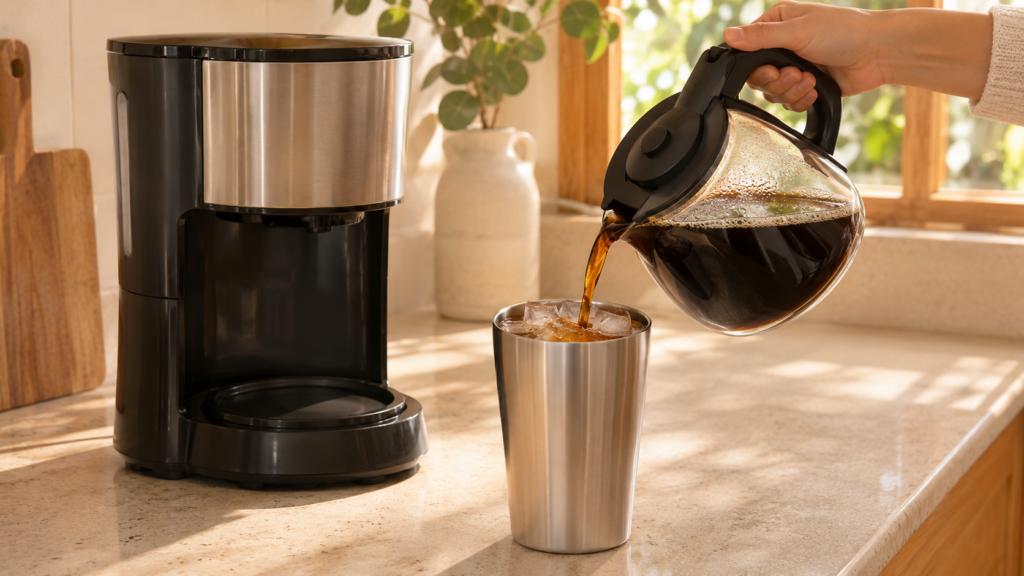
Both methods below work on the drip machine you already own, and neither needs special equipment beyond a kitchen scale and something heatproof to pour into. If you end up making iced coffee every day and want a dedicated setting, our guide to the best iced coffee maker covers machines built for it.
Iced coffee tastes thin when ice melts into coffee brewed at normal strength, so the fix is to plan for that water. Each method does this differently, and the table shows the numbers side by side.
Table of Contents
| Example | Dry coffee | Water into brewer | Ice and cold water in the recipe | Vessel | Servings | Brew water to coffee | All water and ice to coffee |
|---|---|---|---|---|---|---|---|
| Method 1: Double-strength | 40 g | 320 g (320 ml) | 200 g ice (100 g per tumbler) and 120 ml cold water (60 ml per tumbler) | Two 16 oz heatproof tumblers | 2 | 1:8 | 1:16 |
| Method 2: Flash brew | 30 g | 300 g (300 ml) | 200 g | One 32 oz heatproof metal pitcher | 2 small | 1:10 | About 1:16.7 |
The last column counts everything that goes into the drink once the measured ice has melted, and you will get less liquid out because the grounds hold some water back. Both are starting points to adjust, not the one right recipe.
Check your machine’s minimum batch before you start, because both recipes put only about 300 ml through it. One Williams-Sonoma manual says the water must be past the 2-cup step, while Ninja’s CE200 series has a Small Batch button for 4 cups or fewer. If your brewer needs more water, double every amount as long as the grounds still fit the basket: 80 g of coffee, 640 ml of water, 400 g of ice and 240 ml of cold water across four tumblers for Method 1, or 60 g of coffee, 600 ml of water and 400 g of ice in a 64 oz pitcher for Method 2.
How to Make Iced Coffee with a Coffee Maker: Double-Strength Method
The idea is simple: use half the water you normally would for the same coffee. Hot filter coffee is commonly brewed from about 1:16, so doubling the strength gives 1:8, and adding the same weight again in ice and cold water brings the total back to 1:16. For more on the numbers, see our coffee-to-water ratio guide.
Part of that dilution is cold water because a small batch of hot coffee does not carry enough heat to melt 320 g of ice. The sums are 320 g of water ÷ 40 g of coffee = 8, and (320 g of brew water + 200 g of ice + 120 g of cold water) ÷ 40 g of coffee = 16.
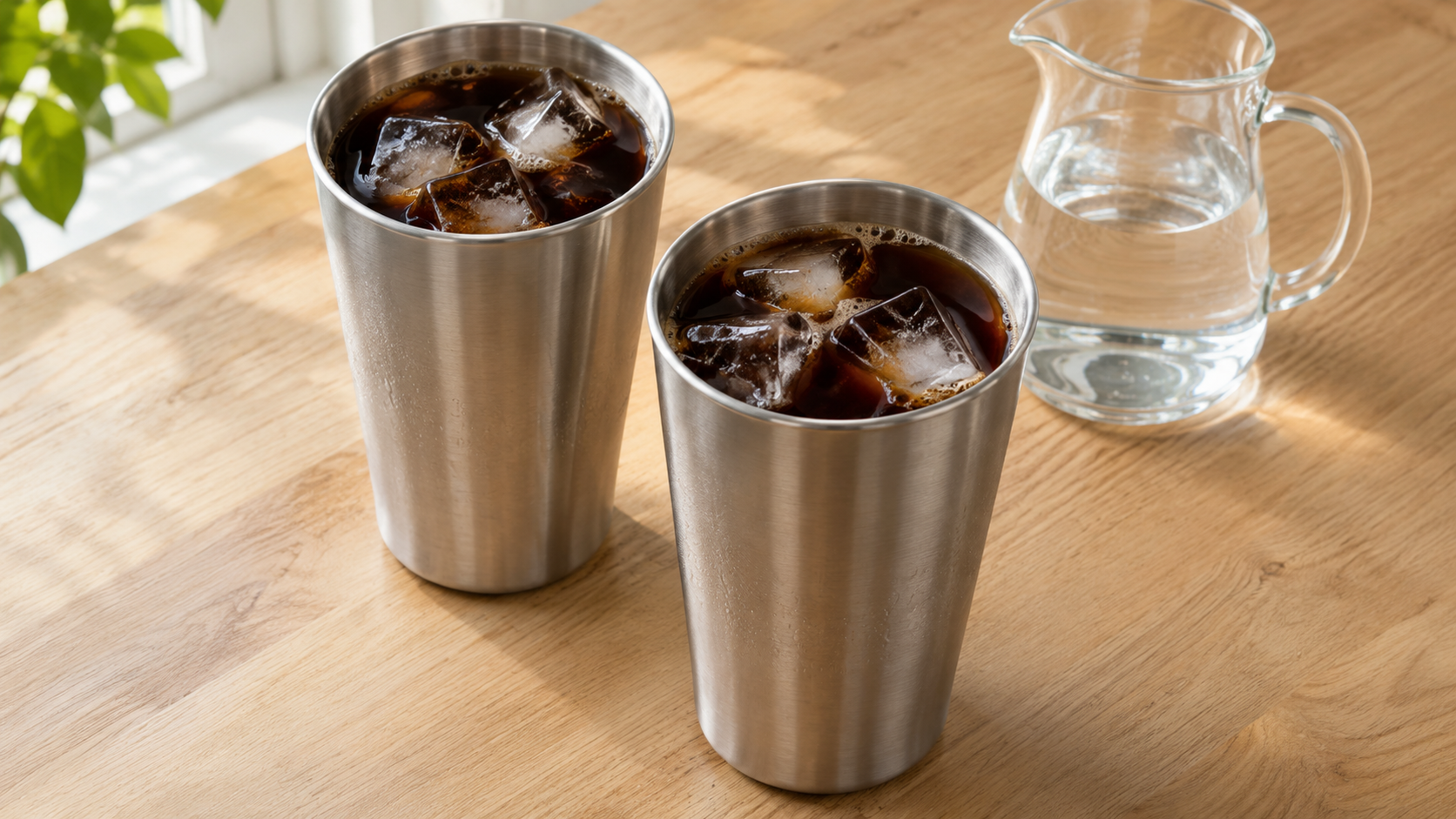
Double-Strength Iced Coffee
A concentrated brew diluted with measured ice and cold water. Check your brewer’s minimum batch and basket capacity. The 1:16 input ratio assumes the measured ice melts; replace any remaining ice with the same weight of cold water. Brew time varies by machine. Allow about 2 minutes to measure the coffee, water and ice; brewing time is additional.
Ingredients
Equipment
Method
- Weigh 40 g of coffee, ground for your drip machine, and put it in the filter basket. That is roughly 8 tablespoons, using Starbucks’ 3 tablespoons to 15 g.
- Pour 320 ml (about 10.8 fl oz) of cold water into the reservoir. Measure it rather than trusting the carafe marks, and add nothing else.
- Brew into the carafe as usual. Turn the machine off when it finishes so the coffee does not sit on the warming plate.
- Put 100 g of ice and 60 ml (about 2 fl oz) of cold water in each of two 16 oz heatproof tumblers, away from the warming plate.
- Pour the coffee slowly and evenly between the tumblers, then stir for a few seconds.
Use a tumbler rather than a drinking glass. Starbucks warns that a glass tumbler is not recommended because the quick temperature change could shatter it.
The 100 g of ice in each tumbler is part of the recipe, and the 1:16 input ratio assumes it has melted. If ice remains once the coffee is cold, remove and weigh the remaining cubes, then replace them with the same weight of cold water. This applies to both methods; stirring alone will not necessarily melt all the ice. Cubes you add afterward are extra serving ice and dilute the drink further as they melt.
Method 2: Flash Brew (Japanese-Style)
Flash brewing also uses less hot water, but here the ice is a measured part of the brew rather than something you serve the drink over. You replace about 40% of the water with ice, a split that also appears in Japanese-style recipes. The hot coffee hits the ice straight away, so it chills in moments instead of cooling slowly.
The two methods overlap, since both brew stronger and use ice to dilute. The practical difference is that Method 1 goes straight into tumblers, while Method 2 makes one chilled batch in a pitcher, ready to pour over fresh ice.
The sums here are 300 g of water ÷ 30 g of coffee = 10, and (300 g of water + 200 g of ice) ÷ 30 g of coffee = about 16.7. The water makes up 60% of that 500 g total and the ice makes up 40%.
- Weigh 30 g of coffee into the filter basket and pour 300 ml (about 10.1 fl oz) of cold water into the reservoir.
- Put 200 g of ice in a 32 oz heatproof metal pitcher, and set it on the counter away from the warming plate.
- Brew into the carafe, then turn the machine off.
- Pour the hot coffee straight onto the ice as soon as it finishes, and stir for a few seconds.
- Serve over fresh ice in tumblers. That extra ice is not counted in the ratio above.
Purists brew directly onto the ice, but most drip machines are not set up for it. Do not add ice to a glass carafe, because Ninja’s manual warns against extreme temperature changes, and only brew into another vessel if your own manual allows it.
The 1:16.7 total assumes all 200 g of ice has melted. If cubes are left and you want them out, lift them out, weigh them and add the same weight of cold water, which keeps that ratio.
Troubleshooting Dilution and Bitterness
Change one thing at a time, so you can tell which change helped.
- Watery: Hold off on serving ice first. If it is still thin, cut the cold water in Method 1 from 60 ml to 40 ml per tumbler, which moves the total from 1:16 to 1:15.
- Too strong: Add 20 ml of cold water to each Method 1 tumbler, which moves it to 1:17, or 30 ml to the whole Method 2 batch, which moves it to about 1:17.7.
- Bitter: Try a slightly coarser grind, and pour the coffee off the warming plate as soon as it finishes.
- Sour or thin: Try a slightly finer grind.
- Grounds overflowing: Your basket is too full for this dose. Scale the recipe down only if the water stays above your machine’s minimum; if it does not, switch to Method 2’s 1:10 ratio, which uses less coffee for the same water.
Other Easy Routes
If your machine takes pods, our guide to iced coffee on a Keurig has the steps for that system. If you can plan a day ahead, cold brew in a French press steeps overnight and needs no hot water at all.
FAQ
Can I put ice in the coffee maker?
No. Ice and milk never go in the reservoir, and manufacturers such as Ninja say so directly. Only cold water belongs there.
Can I make the coffee ahead?
Yes. For a make-ahead version, replace the recipe ice with the same weight of cold water during preparation: for Method 1, add 320 ml of cold water to the brewed coffee (120 ml already specified plus 200 ml replacing the ice); for Method 2, add 200 ml. Then refrigerate in a covered container. Do not add this water again to an already diluted batch. Any ice added when serving is extra and will dilute the drink further as it melts.
Is flash brew the same as cold brew?
No. Flash brew uses hot water and is cooled by ice within minutes, while cold brew steeps in cold water for hours. They are made differently, so do not expect them to taste the same.
Do I need special coffee?
No. Use a coffee you already enjoy hot, ground for your machine. Both recipes start from your normal grind.
Start with Method 1, then try flash brew if you want a batch ready to pour. Our home brewing guide has more ways to use the equipment you already have.
