
Welcome to Tea or Coffee. Explore our practical guides designed for better focus and steady energy throughout your day.
How to Make Espresso in a French Press (Strong Coffee for Milk Drinks)
A French press cannot make true espresso, but it can brew a strong concentrate for milk drinks. Here is a simple 1:10 starting recipe.
The honest answer: If you are searching for how to make espresso in a French press, know that it cannot make true espresso or true crema. Espresso relies on water forced through a compact coffee puck, while a French press steeps coarse coffee and then filters it. What it can do is brew a strong immersion concentrate that holds its own in a latte, as long as you do not expect machine-level pressure, texture or strength.
Table of Contents
Quick Recipe Card
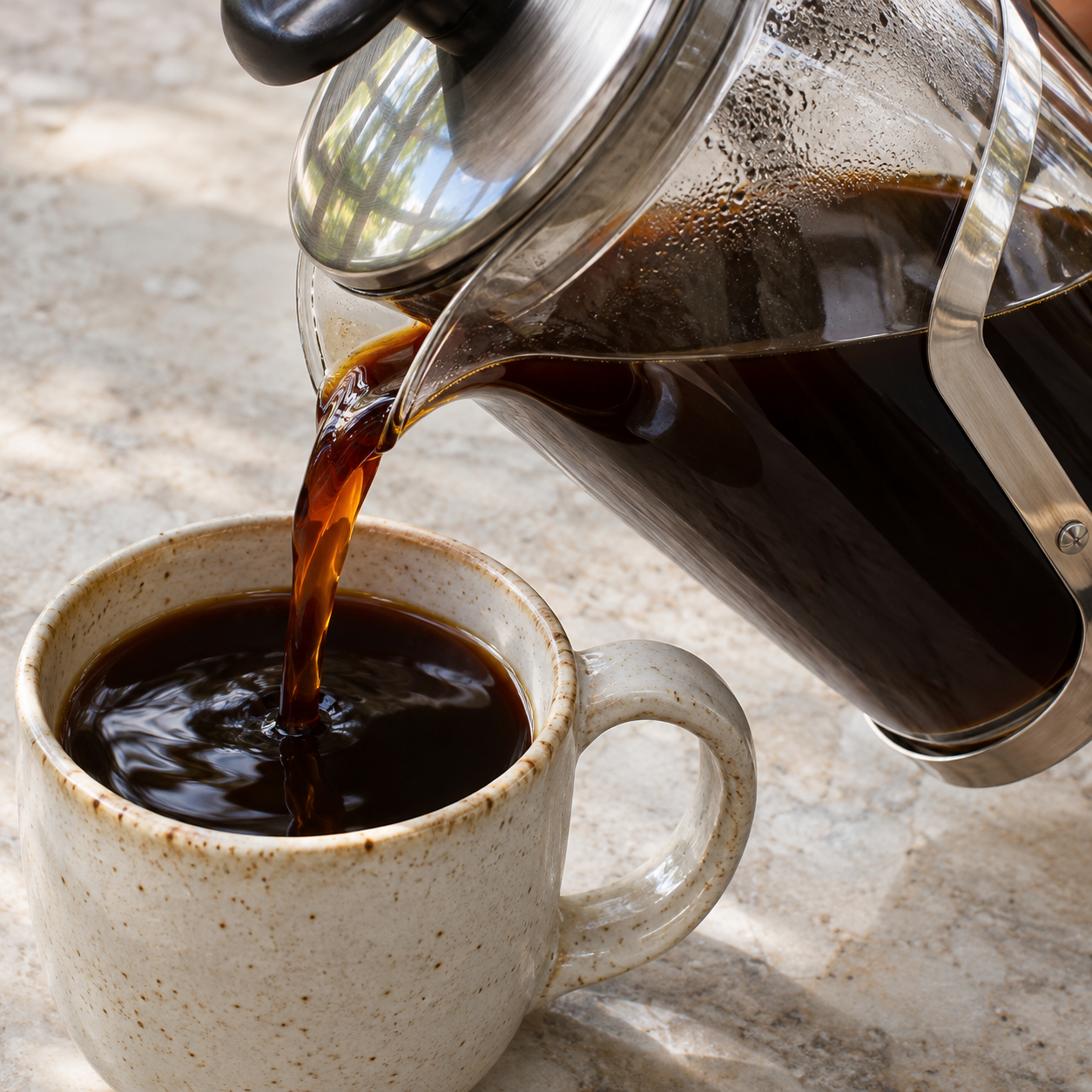
French Press Coffee Concentrate
Strong immersion coffee for milk drinks, not true espresso or crema. Ratio: 1:10. Coarse grind; steep for 5 minutes. This is an editorial starting point, not a manufacturer recipe or a result we tested. Yield is less than 300 ml. Start with 120 ml coffee and 180 ml milk per latte.
Ingredients
Equipment
Method
- Add the coffee to the French press.
- Pour in the hot water and stir gently with a wooden or plastic spoon.
- Put the lid on with the plunger raised, and steep for 5 minutes.
- Lower the plunger slowly, with minimal pressure.
- Pour the coffee into a heat-safe jug or mug straight away.
How to Make Espresso in a French Press: Step-by-Step
These steps add the reasons behind the recipe card. Follow your press manufacturer’s capacity and safety instructions if they differ, and take care around hot water.
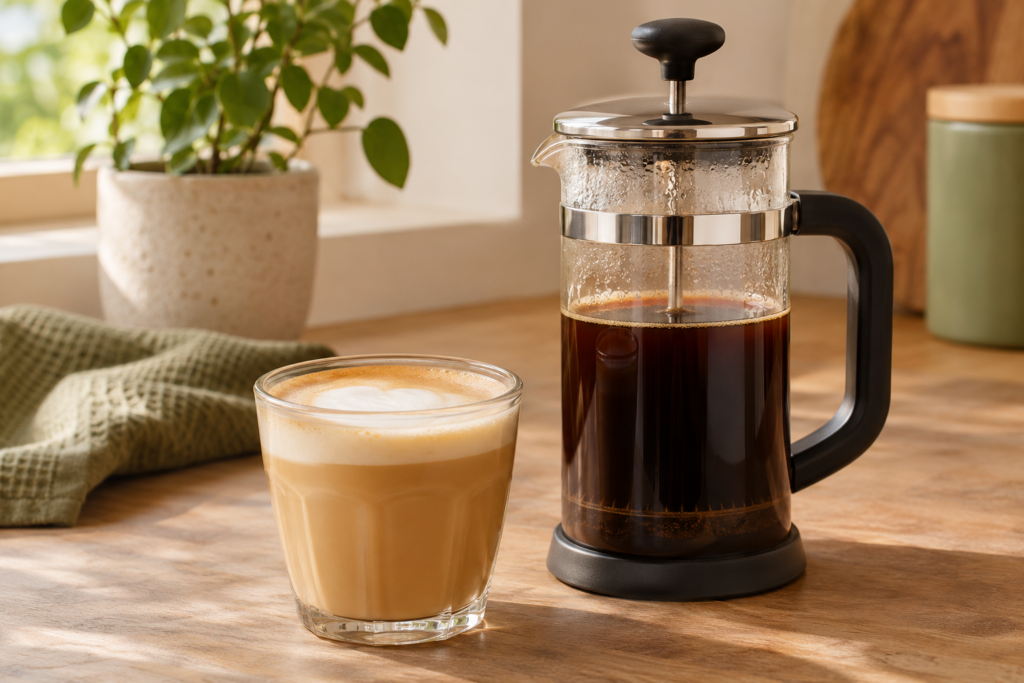
- Grind coarse. Use a coarse grind, which Espro compares to sea salt. Do not use an extra-fine espresso grind, because Bodum warns that fine grounds can clog the filter and create high pressure.
- Heat the water. Bodum’s instructions call for hot, not boiling, water, so let the kettle settle for a moment after it clicks off. Keep hot water away from children.
- Add coffee and water. Put in 30 g of coffee, then pour over 300 ml (10 fl oz) of water and stir gently with a wooden or plastic spoon so all the grounds are wet. A metal spoon can damage a glass carafe, as Bodum warns. Bodum says to leave at least 1 inch (2.5 cm) of space at the top, so check that your press has room.
- Steep for 5 minutes. The recipe of 30 g, 300 ml and 5 minutes is our editorial starting point.
- Press slowly. Lower the plunger with minimal pressure, as Bodum advises, because excessive force can make scalding liquid shoot out of the pot. If it resists, stop pressing and follow the instructions for your model.
- Pour it off. Decant the coffee straight away, so it stops steeping on the grounds. You will get less than the 300 ml you put in, because the grounds keep some water, so measure what you pour off to see how many portions you have.
To make less, keep the 1:10 ratio. For example, 15 g of coffee to 150 ml (5 fl oz) of water uses the same proportions.
A finer grind can look like the obvious way to get closer to espresso, but a press is not built for it. Its filter needs coarse grounds to hold back, so this recipe gets its strength from using more coffee per milliliter of water.
Troubleshooting
Change one thing at a time, so you can tell what helped.
Too weak: Use a little less water next time, and keep everything else the same.
Too sour: Steep a little longer next time, and keep everything else the same.
Too bitter: Steep for a shorter time, because Espro notes that over-extraction can lead to bitterness.
Gritty: Use a coarser grind, and leave the last of the coffee behind when you pour.
Plunger is hard to press: Stop pressing and follow the instructions for your model. A grind that is too fine is one possible cause, so try a coarser grind next time.
Using It in Milk Drinks
Two separate jobs make a latte: brewing the coffee and texturing the milk. This recipe only handles the first, and it does not become espresso once you add milk.
Our guide on how to make a latte at home uses 1 part strong coffee to 1.5 parts milk in its no-machine version. That means 120 ml (4 fl oz) of this coffee with 180 ml (6 fl oz) of milk as a starting portion. Do not swap in the 1:4 espresso ratio from that guide, because you cannot assume this concentrate is as strong as espresso.
From there, adjust to taste: add milk in 30 ml (1 fl oz) steps if the cup tastes too strong, or use 150 ml (5 fl oz) next time if it tastes too mild. To texture the milk, you can froth milk in a French press, and it is worth rinsing the press first if you just brewed in it.
For an iced version, let the coffee cool a little, then use the same 120 ml (4 fl oz) of coffee and 180 ml (6 fl oz) of cold milk over ice in a sturdy 16 fl oz (480 ml) glass. Melting ice will dilute the drink as it sits.
Better Tools for Espresso-Style Coffee
A French press is a good choice if you already own one, but it is not the only route. Our guide on how to make espresso without a machine compares it with other espresso-style methods. If you are choosing a press itself, see our guide to the best French press.
FAQ
Can you make espresso in a French press?
Not true espresso. You can make a strong concentrate that works well as a base for milk drinks, but a French press does not force water through a compact puck, so any foam on top is not crema.
What grind should you use for espresso in a French press?
Use a coarse grind, even though you are aiming for a strong result. Strength comes from the higher coffee-to-water ratio here, not from grinding finer.
How much coffee should you use?
Start with 30 g of coffee for 300 ml (10 fl oz) of water, then scale up or down at the same 1:10 ratio. Stay within your press’s capacity and leave space at the top.
Can you use pre-ground coffee?
Yes, if it is ground coarsely enough for a French press. Coffee ground for espresso machines is too fine for this method, so check the label before you buy.
Is French press concentrate as strong as espresso?
Do not assume it is. This recipe has not been measured against espresso, so treat it as strong coffee and adjust it by taste.
Start with the 1:10 baseline, change one thing at a time, and keep the plunger slow. For more ways to brew, visit our home brewing guide.
